
MD Psychiatry Resident, MBBS
Share this story
You hit the gym. You eat your chicken and rice. You sleep. And yet the muscle you're working toward seems slower to arrive than you'd like. The missing piece isn't always effort. Often, it's understanding what's actually happening inside your cells after you train, and whether the right conditions are in place for it to work.
Protein synthesis is that process. Get it right, and every rep and every meal compounds into real results. Get it wrong, and you spin your wheels.
Here's what it is, how it works, and how to actually support it.
What is protein synthesis?
Protein synthesis is how your body builds proteins: the structural and functional molecules that make up everything from muscle fibers to enzymes to hormones. Without it, cells cannot grow, repair, or function.
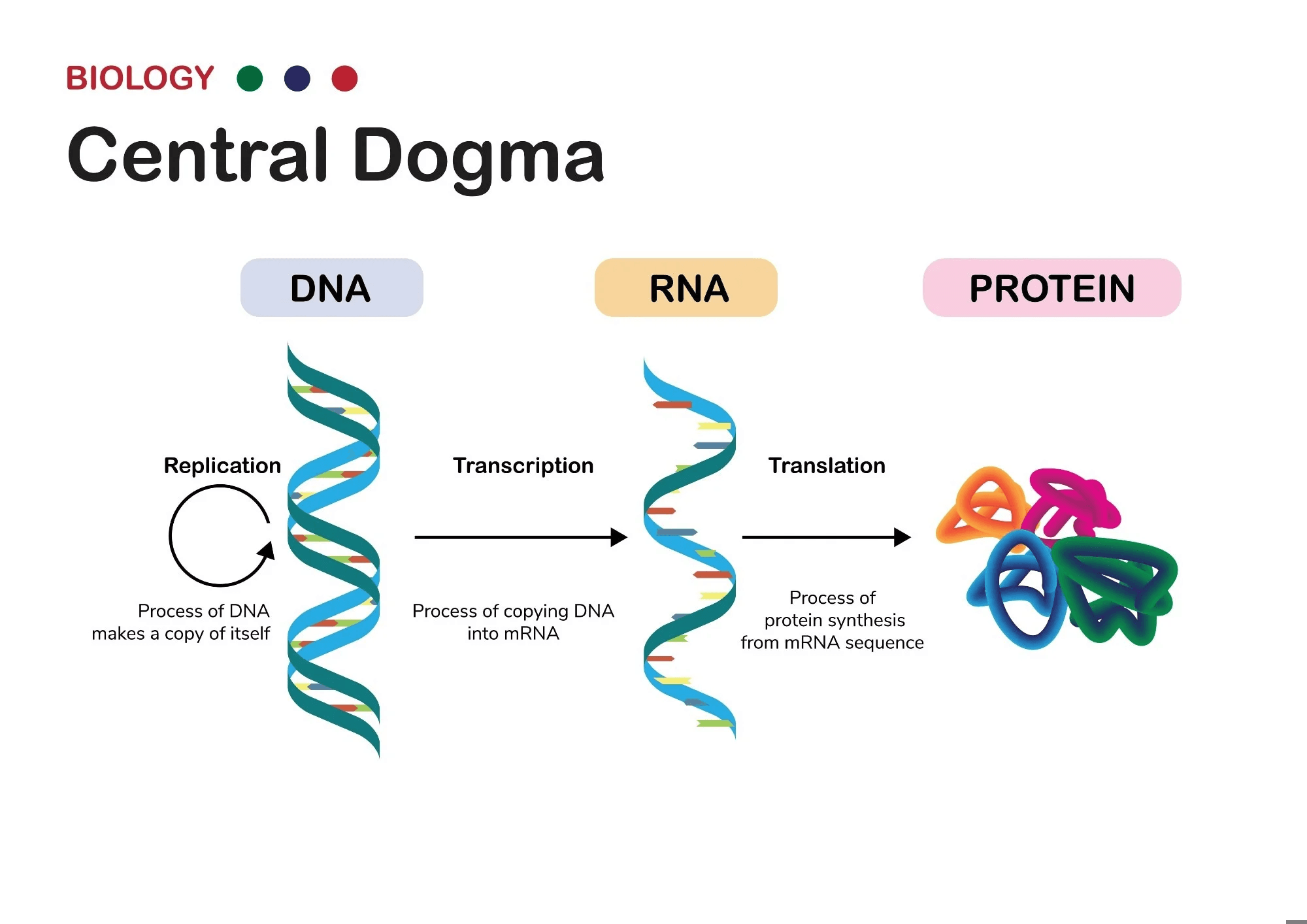
The process converts genetic instructions stored in your DNA into physical, working proteins. Think of DNA as your body's master blueprint. Protein synthesis is the construction crew that reads those plans and builds the actual structures.
The two steps: transcription and translation
Protein synthesis happens in two distinct stages.
Step 1: Transcription (nucleus)
Your DNA never leaves the cell nucleus. So the cell first copies the relevant instructions into a molecule called messenger RNA (mRNA). This copy is portable, meaning it can leave the nucleus and travel to where the building actually happens.
The steps within transcription are [Flag for Sidra Burhan, MBBS, MD: confirm initiation/elongation/termination sequence is accurately described for a lay audience]:
Initiation: An enzyme called RNA polymerase binds to the promoter region of the DNA and begins unwinding the double helix.
Elongation: RNA polymerase reads the DNA template strand and assembles a complementary mRNA sequence, one nucleotide at a time.
Termination: RNA polymerase reaches a stop signal, releases the mRNA transcript, and the DNA rewinds.
The mRNA is then processed and exported from the nucleus.
Step 2: Translation (ribosome)
The mRNA now reaches a ribosome, a molecular machine made of ribosomal RNA (rRNA) and proteins. The ribosome reads the mRNA in three-letter sequences called codons. Each codon specifies one amino acid.
Transfer RNA (tRNA) molecules ferry the correct amino acids to the ribosome, matching their anticodon to the mRNA codon. The ribosome links each arriving amino acid to the growing chain. When it hits a stop codon, the polypeptide is released and folds into its functional shape.
That final folded structure is a protein.
Why this matters for your fitness goals
The biology above is interesting. But what most people reading this actually want to know is: how does this relate to building muscle?
Muscle protein synthesis (MPS) is the specific form of protein synthesis that takes place in skeletal muscle tissue. It's the process that repairs and rebuilds muscle fibers after the micro-damage caused by resistance training.
Your muscle is in a constant state of turnover. Old, damaged proteins are broken down (muscle protein breakdown, or MPB) and new ones are built (MPS). Whether you gain, maintain, or lose muscle depends on which side of that equation wins.
When MPS exceeds MPB, muscle grows. When MPB exceeds MPS, muscle is lost. Your daily habits determine which way that balance tips.
What actually triggers protein synthesis in muscle
Two things reliably drive a meaningful spike in MPS: resistance training and dietary protein. Neither alone is sufficient for sustained muscle growth; you need both, working together.
Resistance training creates mechanical tension and micro-damage in muscle fibers. This signals the body to upregulate protein synthesis to repair and reinforce those fibers. I've found that even a single session of compound lifting (squats, deadlifts, rows) is enough to elevate MPS for up to 48 hours.
Dietary protein provides the raw materials (amino acids) and the molecular signal. The amino acid leucine is particularly important. Once circulating leucine levels rise above a threshold, it activates a pathway called mTOR (mechanistic target of rapamycin), which functions as the cell's master switch for protein synthesis. [Flag for Sidra Burhan, MBBS, MD: mTOR mechanism described at simplified consumer level — verify accuracy of "master switch" framing.]
According to research published in Clinical Nutrition (Lees et al., 2023), leucine availability drives a transient increase in MPS after each meal, followed by a "refractory period" where the muscle temporarily becomes less responsive to further amino acid input, regardless of how much protein you eat. This is the "muscle full" effect.
How much protein you need per meal
The most common question I get is: how much protein per meal actually matters for MPS?
For most healthy young adults, research consistently points to 20–25 g of high-quality protein (like whey, chicken, eggs, or fish) as the amount that maximally stimulates MPS after resistance exercise (Moore et al., 2009; Macnaughton et al., 2016).
For older adults, the threshold is higher. A 2024 review published in Frontiers in Nutrition (Layman, 2024 — DOI: 10.3389/fnut.2024.1388986) found that adults over 60 require meals containing at least 2.8 g of leucine (equivalent to roughly 30 g of protein) to reliably stimulate MPS. Younger adults tend to hit that threshold at a smaller dose.
For overall daily intake, current evidence points to 1.6 g/kg of body weight per day as the level where most people see meaningful muscle gain, with benefits potentially extending to 2.2 g/kg for some individuals (foodmedcenter.org, citing current consensus).
If you're unsure where your daily protein intake actually sits, Zorest Macro's AI Meal Logger can calculate it automatically. Just log your meals by photo or text, and it gives you a live macro breakdown across the day.

Why protein distribution across the day matters
Total daily protein is the biggest driver of muscle growth. But how you spread it across meals plays a meaningful role too.
Research from Dr. Douglas Paddon-Jones (University of Texas Medical Branch), published in the Journal of Nutrition, found that consuming roughly 30 g of protein at each of three meals produced a 25% higher 24-hour mixed muscle protein fractional synthesis rate compared to a skewed distribution, where most protein was consumed at dinner (cited in foodmedcenter.org).
The reason comes back to the "muscle full" ceiling. Because MPS enters a refractory period after each protein meal, grazing on small amounts throughout the day or front-loading all your protein in one sitting both underperform relative to well-spaced, leucine-sufficient meals. The optimal spacing appears to be 3–4 hours between protein-containing meals.
A practical pattern that works for many people: 30–40 g protein at breakfast, lunch, and dinner, with training falling close to one of those meals. No elaborate timing windows or six meals a day required.
Zorest Macro's Daily Meal Planner can help map this out. It generates next-day meal plans based on your current protein targets, spread across your schedule so you're not scrambling to hit your numbers at 10 PM.
Does protein source matter?
Yes, but less than the fitness industry often implies.
Animal-based proteins (chicken, eggs, dairy, fish) have a complete essential amino acid profile and are typically richer in leucine. This gives them a slight anabolic edge per gram. But a 2023 study by Pinckaers et al. in the Journal of Nutrition found that when 30 g of plant-based protein blends were compared to 30 g of milk protein, muscle protein synthesis rates were equivalent in healthy young males (Gatorade Sports Science Institute summary, citing Pinckaers et al. 2023).
The practical implication: plant-based eaters can absolutely support robust MPS. The key is consuming enough, often 30 g or more per meal, and combining sources to cover the full amino acid spectrum.
What limits protein synthesis
Even with adequate protein and consistent training, several factors can constrain MPS.
Calorie deficit. Building muscle requires energy. In a large calorie deficit, the body deprioritizes anabolic signaling. MPS slows because the metabolic environment simply doesn't support growth. If you're cutting, keeping the deficit modest and protein high limits this effect. You can read more on this in our post on how protein supports metabolic health.
Sleep deprivation. Growth hormone, a key anabolic signal, is secreted predominantly during deep sleep. Poor sleep blunts both the hormonal environment and MPS rates directly. One practical workaround: consuming 20–40 g of slow-digesting casein protein before bed has been shown to stimulate overnight protein synthesis in both young and older adults (foodmedcenter.org). A small bowl of cottage cheese or a casein shake can work. [Flag for Sidra Burhan, MBBS, MD: verify specific pre-sleep casein dose and whether "20–40 g" is appropriate across both populations cited.]
Age. Anabolic resistance increases with age. Older adults produce a smaller MPS response to the same protein dose as younger adults, which is why the protein threshold per meal rises. That's why staying active becomes even more critical for preserving muscle as you get older (Ishaq et al., 2025 — PMC12104658).
Prolonged fasting. If you're using fasting protocols, muscle loss isn't automatic, but structure matters. See our post on how to fast without losing muscle for the specific protein and training protocols that protect muscle during a compressed eating window.
Final thoughts
Protein synthesis isn't a fitness concept you need a biology degree to use. At its core, the idea is simple: your body builds proteins from instructions in your DNA and ingredients from your food. For muscle specifically, the inputs that drive this process are consistent resistance training, adequate leucine-rich protein spread across the day, sufficient calories, and decent sleep.
The lever most people are missing isn't the gym. It's the protein side. Specifically, they're either not hitting enough per meal to cross the leucine threshold, or they're stacking too much protein at dinner while eating too little earlier in the day.
If you're tracking your intake and still not seeing progress, Zorest Macro's Weekly AI Coach Call gives you a one-on-one voice session with your AI nutrition coach to audit your protein distribution and adjust your plan. One conversation can often surface the fix.
Got questions? Ping me on LinkedIn.