
MD Psychiatry Resident, MBBS
Share this story
Most people assume that gaining weight automatically slows your metabolism. That assumption is backwards. Weight gain actually raises your BMR — but how much it raises it depends almost entirely on what you gain and how fast you gain it. Get those two variables wrong, and you'll bulk for months, eat in a surplus, and end up with a metabolic return that barely moves the needle. Here's what the research actually says.
What is BMR?
BMR (basal metabolic rate) is the number of calories your body burns just to stay alive — breathing, pumping blood, keeping your organs running. No exercise, no walking, no digestion — just the minimum energy cost of existing.
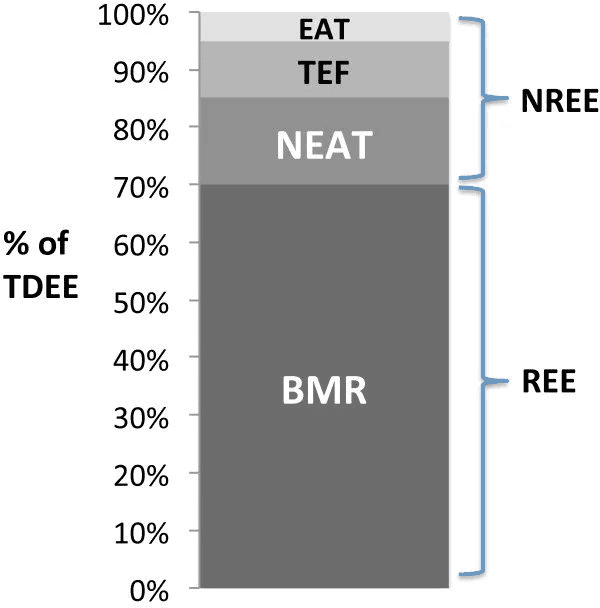
It typically accounts for 60–70% of your total daily energy expenditure, which makes it the single biggest lever in your daily calorie burn. That's why changes to BMR — even small ones — matter for anyone managing their weight.
Weight gain raises BMR — but not all weight is equal
The bottom line: every tissue your body holds burns calories to maintain itself, but not at the same rate.
Here's roughly what different tissues burn per kilogram of mass, according to published metabolic research:
Skeletal muscle: ~13 calories/kg/day
Adipose tissue (fat): ~4.5 calories/kg/day
Liver: ~200 calories/kg/day
Brain, heart, kidneys: ~200–440 calories/kg/day
That difference is why what you gain determines your metabolic return far more than how much you gain.
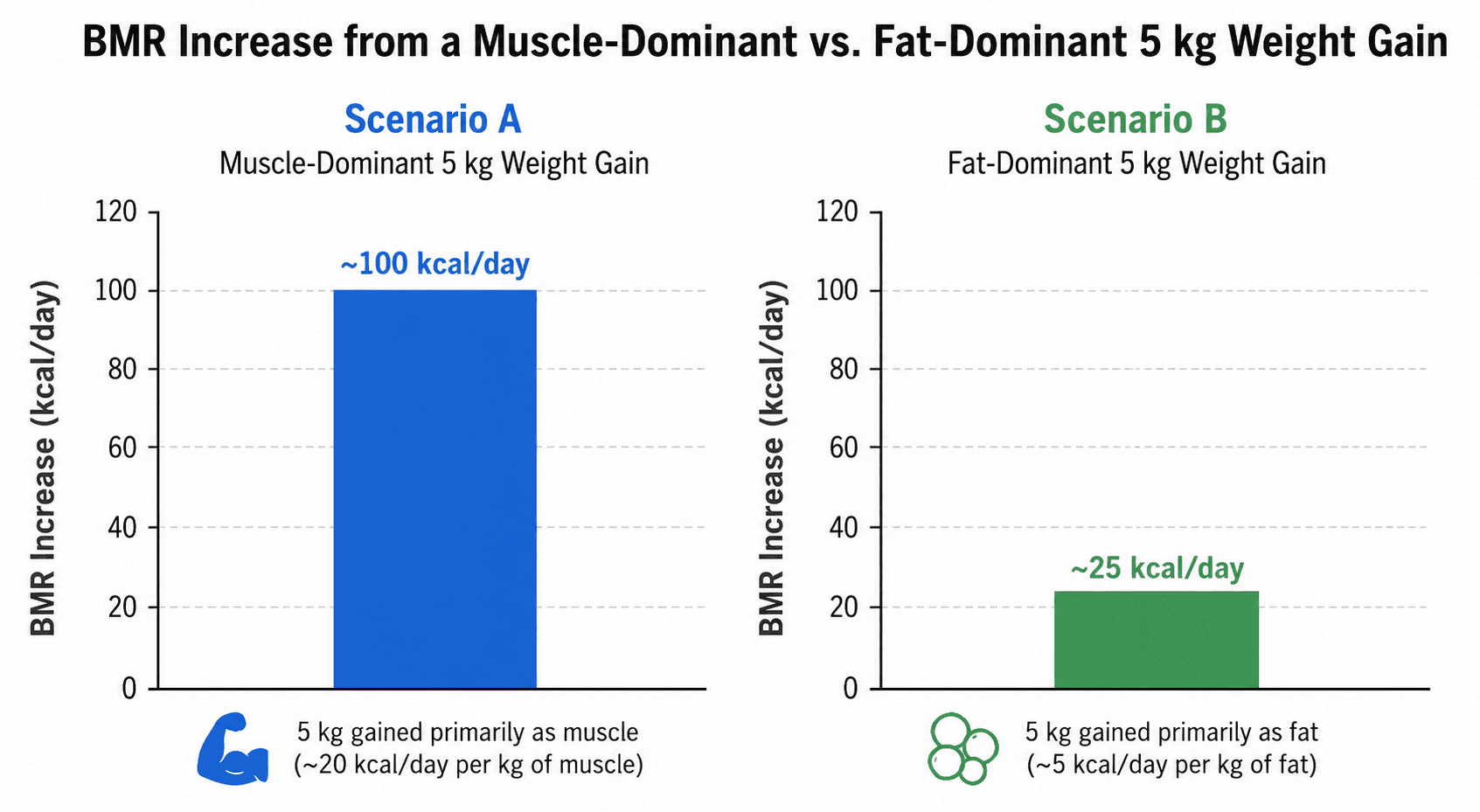
To make that concrete: imagine two people both gain 5 kg over a bulk.
Person A gains 3 kg of muscle, 1.9 kg of fat, and a small increment of supporting organ tissue (~100g). Their BMR increases by roughly 67–68 calories/day.
Person B gains all 5 kg as fat. Their BMR increases by just 22–23 calories/day — less than a third.
Same weight gained. Vastly different metabolic outcome.
Why organ tissue matters more than muscle alone
Here's something that surprises most people: it's not primarily muscle mass that drives BMR upward — it's the high-metabolic-rate organ tissue that scales with a larger, more active body.
Your brain, heart, kidneys, and liver burn roughly 200–440 calories per kilogram — about 15 to 33 times more than skeletal muscle. When you build a heavier, more muscular body through consistent resistance training, your organs also grow proportionally to support the increased physiological demand. That's where a meaningful portion of the BMR increase comes from.
Muscle still matters. A meaningful amount of muscle also increases the metabolic activity of your liver and other organs by requiring more protein turnover, more blood supply, and more energy for tissue maintenance. But if you were expecting 5 kg of new muscle to add 200 calories to your daily burn, the math puts the return closer to 65 calories.
That's still worth chasing — both for body composition and the downstream benefits to your metabolic health. But calibrate your expectations to what the biology actually supports.
The short-term metabolic boost when you start gaining weight
This is where things get interesting — and where a lot of reverse dieting hype originates.
When you shift into a calorie surplus, your BMR often jumps up faster than the tissue you've gained would predict. In an 8-week overfeeding study by Harris and colleagues, subjects' BMR increased by about 100 calories per day within the first two weeks — while they'd only gained around 2 kg of bodyweight. That's a disproportionately large jump relative to the tissue added.
So is this "metabolic adaptation in reverse"? Not exactly.
The critical difference from weight loss adaptation is what happens over time. With sustained calorie restriction, metabolic adaptation tends to persist and even worsen as weight loss continues. With weight gain, the early boost fades as you keep gaining. By weeks 4–8 of that same study, subjects' BMR had essentially plateaued, and per unit of fat-free mass, it was nearly identical to baseline.
A 2023 review in the Philosophical Transactions of the Royal Society confirmed this pattern across the overfeeding literature: studies of 30–100 days consistently show metabolic rate increases of 5–12% with weight gain, but once corrected for the additional body mass, that increase disappears entirely. The thermogenic signal reflects the new tissue, not a compensatory metabolic "upgrade."
The short-term boost is real. But it's transient, not structural.
What this means if you're transitioning out of a diet
If you've just finished a cut, the math gets layered in a useful way.
Sustained calorie restriction lowers BMR through metabolic adaptation. One of the most dramatic demonstrations of this is the Fothergill et al. follow-up of Biggest Loser contestants, where participants showed meaningfully depressed resting metabolic rates six years after their competition — well beyond what weight loss alone would predict.
When you shift back into a surplus from that state, two things happen at once:
The deficit-driven suppression begins to lift — part of the suppressed BMR returns simply from exiting the energy deficit.
The short-term surplus boost layers on top — your BMR temporarily rises further, creating a window where metabolism feels noticeably elevated.
Combined, that swing can account for a 10–20% shift in how your metabolism feels. I've seen clients eating in a moderate surplus report feeling consistently warmer, more energetic, and more mentally clear within 2–3 weeks. That's the physiology working.
But half of that effect comes from simply stopping the deficit — which means it could be achieved without a formal reverse diet protocol. And the other half is a short-lived adaptation that fades as the new bodyweight stabilizes. If you want to understand how long this transition typically takes and what the evidence says about reverse dieting protocols, the reverse dieting timeline guide goes deep on the actual study data.
Three levers that determine your BMR return from weight gain
The research points to three variables that consistently shift your BMI return per kilogram gained. Stack all three and you get the best possible metabolic outcome from a bulk.
1. Rate of weight gain
Faster surpluses and more aggressive bulking lead to a larger proportion of fat per kilogram gained. A slower rate — roughly 0.25–0.5% of bodyweight per week — shifts that ratio toward lean mass, which burns more calories per kilogram at rest. Patience pays off metabolically.
2. Resistance training
Consistent lifting significantly increases fat-free mass per unit of weight gained compared to eating more without a training stimulus. Muscle gained through progressive resistance training is high-quality lean mass — and it drives the organ-level metabolic scaling discussed above. No shortcut replaces this.
3. Protein intake
Higher protein during a surplus is independently associated with greater fat-free mass accrual, especially when paired with training. Current evidence supports a target of roughly 1.6–2.2g per kilogram of bodyweight for people training consistently.
That combination — modest surplus, consistent training, adequate protein — gives you the highest metabolic return per kilogram of weight gained.
The protein target is often the piece that slips first when people start eating more. As calories go up, it's easy to hit your surplus through carbs and fats without noticing that your protein
Putting it together: what to actually expect
A quick, practical summary of what the science predicts:
Gaining 5 kg of mostly fat: BMR increases by roughly 22 calories/day. You're heavier, but your metabolism barely registered the change.
Gaining 5 kg with a strong lean mass component: BMR increases by 65–70 calories/day. Still not dramatic in absolute terms, but far better — and the compounding effect over months is meaningful.
First 2–4 weeks of a new surplus: Expect a temporary metabolic boost beyond what the tissue gain predicts. Enjoy it — it's real — but don't confuse it with a permanent shift.
After 2–3 months at the new weight: BMR returns to a level proportional to your new tissue composition. That's your new baseline.
None of this is dramatic on a per-week basis. That's the honest reality of metabolic physiology. But it does mean that how you structure a bulk — slow, training-supported, high-protein — has a tangible long-term impact on where your BMR lands.
Final thoughts
Weight gain increases BMR — the science is consistent on that. The nuance is that fat-dominant weight gain provides a much smaller metabolic return than lean mass-dominant weight gain, and the short-term "boost" you feel when you first enter a surplus is real but temporary.
The practical upshot is straightforward: a slow, protein-anchored, training-supported bulk gives you the best possible BMR outcome per kilogram gained. Aggressive, unstructured overeating might hit a weight target faster, but its metabolic return is limited.
Understand the tissue composition math, and you'll approach weight gain with a clearer strategy — not just a calorie target.