
MD Psychiatry Resident, MBBS
Share this story
A client of mine finished a four-month cut last year and lost 18 pounds. Then she froze. "I don't want to eat more," she told me, "because I don't want it to come back." That fear is exactly why reverse dieting exists. After weeks of eating less, your body adapts to running on less fuel, so jumping straight back to your old intake can trigger fast fat regain. Reverse dieting fixes this by raising your calories slowly enough for your metabolism to catch up. But how long does "slowly" actually mean? I went looking for a real answer, including a 2025 clinical trial that most reverse dieting guides haven't caught up to yet.
What reverse dieting actually fixes in your body
What is reverse dieting?
Reverse dieting is the practice of raising your calorie intake in small, planned increments after a diet, instead of jumping straight back to your old eating pattern. The goal is to limit fat regain while your metabolism adjusts to running on more fuel again.
Your body doesn't treat "the diet is over" as a switch. After weeks of eating less, several systems quietly downshift to protect you from what your biology still reads as a food shortage. Leptin, the hormone that signals fullness, drops with body fat and calorie intake. That pushes hunger up and energy expenditure down.
Your nonexercise activity thermogenesis, or NEAT, often falls too. NEAT is simply the calories you burn fidgeting, pacing, and standing instead of sitting. It's not dramatic on its own, but across a full day it adds up, and dieting quietly shrinks it.
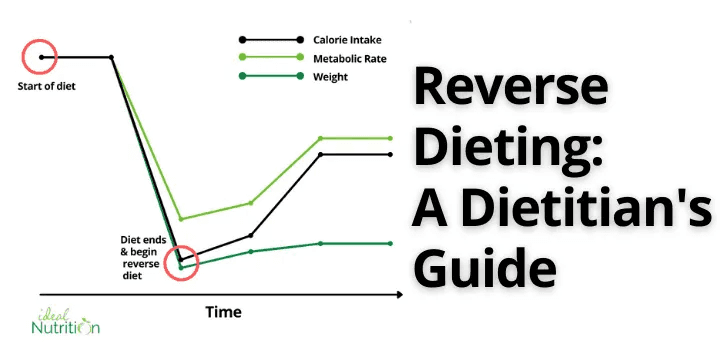
How far this adaptation can go is captured well by the long-term "Biggest Loser" follow-up. Six years after that extreme 30-week weight-loss competition, contestants' resting metabolism was still burning roughly 700 fewer calories a day than their body size predicted, even though most had regained the bulk of the weight they'd lost (Fothergill et al., 2016). That's a far more extreme diet than almost anyone reading this has attempted. But it proves the adaptation is real and can outlast the diet that caused it. An adjustment built up slowly over months gets unwound the same way, not overnight.
How long reverse dieting actually takes
Most reverse diets run somewhere between four and twenty weeks. The number that matters isn't a generic average, though. It's the gap between what you're eating now and your true maintenance calories, divided by how fast you choose to close it.
Here's the actual math. Say you finished your diet eating 1,500 calories, and your estimated maintenance is 2,100. That's a 600-calorie gap. Increase by 75 calories a week, a common mid-range pace, and you're looking at eight weeks. Increase by 40 calories a week instead, and it stretches to fifteen. Researchers running the largest reverse dieting trial to date used weekly increases of 8.5% for men and 11.7% for women (Rodriguez Da Silva et al., 2025), while most coaches default to flatter 50-to-100-calorie weekly bumps. Either approach gets you there, just on a different schedule.
Three things push your number up or down within that range:
How long and how strict your diet was. A four-week mini-cut barely dents your metabolism. A sixteen-week contest-prep style cut adapts it hard. The bigger the gap you're climbing out of, the longer the climb takes, even at the same weekly increase.
What you're actually trying to achieve. Just want to stop losing weight without rebounding? You can often stop the moment your weight trend flattens. Trying to fully restore your old maintenance level, or build muscle while doing it, takes longer because you're pushing intake past simple maintenance.
How consistently you can track. A precise weekly increase only works if your logged intake matches your real intake. If you're estimating by eye, plan for a slower pace and more buffer weeks, since small calorie creep is exactly what turns a clean reverse diet into a stall.
For my client, the four-month cut meant I had her plan on roughly ten to twelve weeks, adding calories every two weeks based on her weight trend. She hit maintenance in nine. If you want a head start on the maintenance number itself, our guide to calculating your true TDEE walks through it step by step.
What the first real reverse dieting trial found
Here's where the story gets more interesting than most reverse dieting guides let on. The most rigorous test of reverse dieting to date, run out of the University of South Florida's Performance and Physique Enhancement Lab, found it didn't beat simply eating intuitively. And the people following it quit nearly twice as often.
The setup: 49 resistance-trained adults dieted until they'd lost 5% of their body weight, then split into three groups for 15 weeks. One group reversed gradually, using the 8.5%/11.7% weekly increase mentioned above. One jumped straight to a calculated maintenance number. One simply ate ad libitum, however much they wanted. Average weight regain came in at 3.68% for the reverse group, 2.73% for the immediate-maintenance group, and just 1.30% for the ad libitum group (Rodriguez Da Silva et al., 2025). The differences didn't reach statistical significance, but notice the direction: the slow, careful approach regained the most weight on average, not the least.
A companion study from the same research group found reverse dieters dropped out at nearly double the rate of the ad libitum group, 45.2% versus 23.8% (Rodriguez Da Silva et al., 2025). A related weekly survey comparing the same three strategies turned up something I found genuinely surprising. By the later weeks, the reverse dieters reported less hunger and more fullness than the other two groups. The appetite side of the theory held up. But they still rated the diet harder to stick to than the people eating however they wanted (Monahan et al., 2025). These reverse dieters struggled with the tracking and patience the protocol demanded, not with hunger.
I want to be fair to the data here. This was a small, early-stage trial. Participants only lost 5% of their body weight, nowhere near a sixteen-week contest-prep cut, and 15 weeks isn't a long follow-up. It doesn't prove reverse dieting is pointless for someone who dieted hard and long, where the metabolic adaptation research still favors slow refeeding. What it does show is that "slower is automatically better" isn't a safe assumption anymore, and that the structure itself carries a real cost most reverse dieting content skips over.
The week-by-week protocol that makes it work
If your diet was long or strict enough that a structured reverse still makes sense, here's the sequence I actually use with clients.
Find your real ending intake first. Don't use your diet's official target. Use what you actually ate, averaged over the last week or two. Precise logging earns its keep here. A tool like Zorest Macro's AI Meal Logger, which reads a photo, barcode, or food label and does the math automatically, removes the guesswork that turns a clean 75-calorie weekly increase into an accidental 200-calorie one.
Pick your weekly increase and lean it onto carbs and fat. Hold protein steady at the higher end of the range, somewhere around 1.6 to 2.2 grams per kilogram of bodyweight. Research on resistance-trained individuals shows higher protein intake during calorie-restricted or recovering periods helps protect lean mass (ISSN position stand, 2017). For the full breakdown by goal and bodyweight, see our protein guide.
Track three signals weekly, not just the scale. Watch your seven-day average weight trend, your hunger and fullness, and one performance marker, whether that's a lift, a run pace, or your energy level at three in the afternoon. A single day's number is noise. A flat trend across two weeks with stable hunger is your green light to add more.
Adjust based on the trend, not the mood. If your weight trend climbs faster than expected, hold your current intake for an extra week instead of cutting back. That's still progress, just slower. A weekly check-in, like Zorest Macro's Weekly AI Coach Call, helps here specifically because someone is reading the data with you instead of you eyeballing a wobbly graph alone at eleven at night.
Decide your stopping point before you start. Either you hit your calculated maintenance number, or you hit a personal cap on how much scale movement you're willing to accept, whichever comes first. I've watched more clients get stuck reversing forever than regain too much weight too fast.
When reverse dieting isn't worth the effort
Skip the formal protocol if any of these describe you.
Your diet was short or mild. A few weeks of modest restriction doesn't build the kind of adaptation that needs careful unwinding. Move close to your estimated maintenance and watch your weight trend for two weeks, instead of stretching out a timeline you don't actually need.
You're burned out on tracking. The 2025 data above is relevant here. The ad libitum group in that trial regained the least weight, not the most. If months of weighing food have worn you down, eating reasonably with a protein-forward plate and no spreadsheet is a legitimate strategy, not a cop-out.
You have a history that makes calorie math risky. Anyone with a history of disordered eating, or a medical condition affecting appetite, weight, or metabolism, should work through this with a doctor or registered dietitian instead of a generic timeline from any blog post, including this one.
If your weight loss stalled before you even started reversing, our piece on diet plateaus covers the usual culprits, most of which have nothing to do with willpower.
Final thoughts
Most reverse diets take somewhere between four and twenty weeks. You can estimate yours with one calculation: the calorie gap between your current intake and your true maintenance, divided by the weekly increase you're willing to commit to. Treat that number as a starting estimate, not a contract.
The bigger lesson from the 2025 trial is that the variable deciding whether a reverse diet works well usually isn't the exact week count. It's whether you can sustain the structure long enough to see it through. So don't start by picking a twelve-week plan off a chart. Pick a two-week test increase, log it accurately, and let your own data, not a generic timeline, tell you what happens next.