
MD Psychiatry Resident, MBBS
Share this story
Fasting has a muscle problem — or at least, that's what people believe. Search the topic for five minutes and you'll find threads full of people convinced that the moment they stop eating for 16 hours, their body starts dissolving muscle for fuel. I've heard it from gym-goers, from clients, from readers. "I don't want to fast because I'll lose gains."
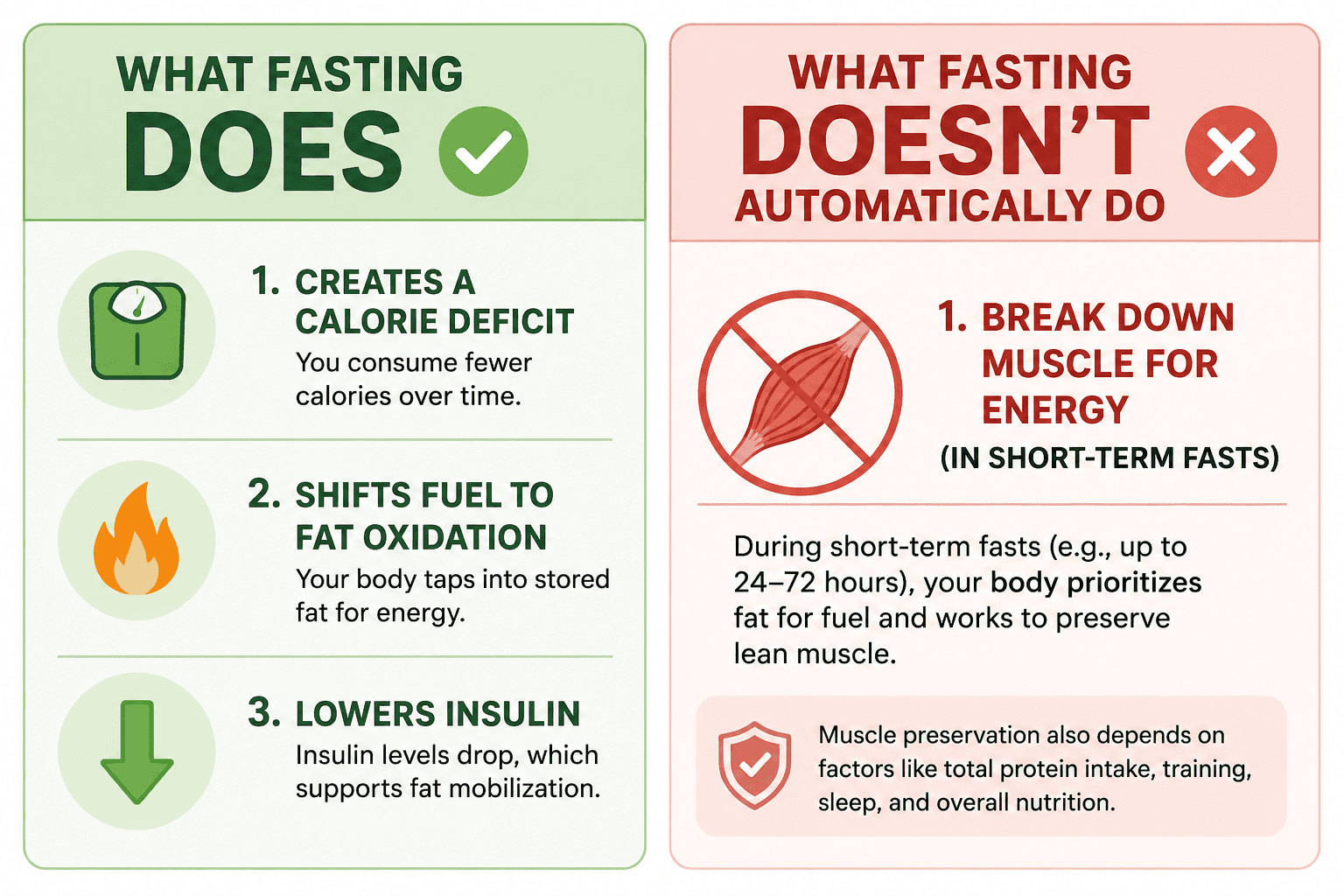
Here's what the research actually shows: fasting doesn't automatically cause muscle loss. Whether you lose muscle depends on what you do around the fast — your protein intake, your training, and your fasting window length. Get those right, and you can fast and preserve muscle.
Does fasting cause muscle loss?
The short answer is: not necessarily, especially with shorter fasting windows.
A 2020 systematic review of eight studies published in PLOS ONE found that intermittent fasting (IF) paired with resistance training generally maintained lean body mass while also promoting fat loss.
A 2022 European Journal of Nutrition RCT took this further: participants doing 5:2 intermittent fasting combined with resistance training showed similar improvements in lean body mass, muscle size, and strength compared to those doing continuous energy restriction, as long as protein intake hit at least 1.4g per kilogram of body weight per day.
So fasting in and of itself isn't a muscle-burning process. The conditions around it are what matter.
When fasting does burn muscle
That said, there are conditions under which fasting pushes your body toward muscle breakdown. Knowing them helps you avoid them.
Prolonged fasts: A 2024 study found that fasting beyond 24–48 hours significantly increases the risk of muscle breakdown. This is where the body, running low on glucose and glycogen, ramps up gluconeogenesis — breaking down amino acids from muscle tissue to produce glucose. A standard 16:8 fast doesn't get there. A 72-hour water fast almost certainly does.
Low protein intake: This is the biggest variable. A 2024 meta-analysis in Clinical Nutrition ESPEN found that protein intake below 1.0g per kilogram of body weight per day is associated with a significantly higher risk of muscle mass decline during weight loss. If you're eating one small meal during a compressed window and barely hitting your protein, the fast isn't the problem — the diet is.
No resistance training: Muscle exists because the body has a reason to maintain it. Remove the stimulus (i.e., stop lifting), and muscle mass becomes metabolic overhead your body is happy to shed, especially in a caloric deficit.
Excessive calorie restriction on top of fasting: Stacking a severe deficit with a long fasting window is a recipe for lean mass loss. If you're eating 900 calories in a 4-hour window, no amount of protein optimization fixes that.
Hit your protein target during your eating window
Protein is the most powerful lever for muscle preservation during a fast. The research on this is consistent.
That same 2024 meta-analysis found that protein intake exceeding 1.3g/kg/day is expected to produce muscle mass gains, while 1.2–1.6g/kg/day reliably prevents muscle loss during calorie restriction. For context: for a 70kg person, that's roughly 85–112g of protein per day. For someone lifting and cutting, I'd push that closer to 1.6–2.0g/kg — so 112–140g daily.
The challenge with fasting is fitting all of that into a compressed window. Here's what I've found works:
Prioritize protein at your first meal. Breaking your fast with 30–40g of protein immediately stimulates muscle protein synthesis and sets the tone for the rest of the day.
Don't let any single meal fall below 25g of protein. Research suggests that muscle protein synthesis is maximally stimulated at roughly 0.4g/kg per meal, and amounts below ~20–25g provide a suboptimal anabolic signal.
Use easy, high-protein foods: Greek yogurt, eggs, cottage cheese, grilled chicken, canned fish. These make it easier to hit 120g+ without overthinking it.
If you're not sure how much protein you're actually getting, Zorest Macro's AI Meal Logger makes it easy to check — just log your meals by text or photo and it instantly breaks down your protein, carbs, and fat for the day.
Lift weights: it's non-negotiable
Protein gives your muscles a reason to grow. Resistance training gives them a reason to survive.
When you're in a calorie deficit — which fasting creates — your body is constantly reassessing which tissue is worth keeping. Muscle is expensive: it burns calories even at rest. If you're not sending a clear signal that you're using it, your body treats it as expendable.
The systematic review from PLOS ONE is clear on this: the studies that showed lean body mass maintenance during IF were the ones that included resistance training. The ones that didn't include training showed greater lean mass losses. The training doesn't need to be elaborate — three sessions a week of compound lifts (squats, deadlifts, rows, presses) is sufficient for a maintenance signal.
A 2022 systematic review in ScienceDirect found that intermittent fasting combined with resistance training produced reductions in fat mass and body fat percentage while preserving fat-free mass — the best possible body composition outcome from a fasting protocol.
One practical note: training timing matters less than many people think. You don't need to train in a fed state to preserve muscle. But if you find you perform significantly worse when fasted, train during your eating window. Performance matters because training quality directly affects the muscle-retention signal you're sending.
Distribute your protein across the eating window
Here's the nuance most fasting guides miss: muscle protein synthesis (MPS) is stimulated by protein ingestion events, not just daily totals.
A 2021 paper from the University of Toronto made a compelling case that intermittent fasting's compressed eating window — and the infrequent feeding it implies — may be suboptimal for muscle protein remodeling. The argument is that MPS is a pulsatile process: it spikes after protein intake and returns to baseline within a few hours. Eating all your protein in one or two large meals means long stretches where MPS is low and breakdown can accumulate.
The practical fix is to spread protein across at least two to three meals within your eating window, even if that window is only eight hours.
For example, on a 16:8 schedule (eating noon to 8pm), this might look like:
12pm: Lunch with 40g protein (grilled salmon and lentils)
4pm: Snack with 25g protein (Greek yogurt and almonds)
8pm: Dinner with 45g protein (chicken, egg, and vegetables)
This totals 110g across three feeding events — a much better muscle signal than eating 110g all at once at 6pm.
If you want a meal plan structured this way, Zorest Macro's Daily Meal Planner can build one around your eating window, calorie target, and protein goal — without you having to calculate anything manually.
Choose the right fasting protocol for muscle
Not all fasting protocols carry the same muscle risk. Here's how the common ones stack up:
16:8 (eat in an 8-hour window, fast for 16 hours): The most studied and the safest for muscle. The fasting window is short enough that gluconeogenesis from muscle protein isn't a significant concern. This is the protocol I'd recommend for anyone new to fasting who wants to preserve muscle.
5:2 (eat normally five days, restrict to ~500 calories two days per week): Also workable, as shown in the 2022 RCT above. The key is hitting your protein targets on the five normal days and not going protein-deficient on the two restricted days.
OMAD (one meal a day): Riskier for muscle. A 23-hour fast is long enough to significantly suppress insulin and elevate cortisol, and getting 120+ grams of protein in a single meal is hard to do consistently. Not the worst option for fat loss, but suboptimal for muscle preservation.
Extended fasting (48h+): The 2024 study is clear that prolonged fasting measurably increases muscle breakdown. If you want to do occasional extended fasts, fine — but don't make them a regular strategy if retaining muscle is a priority.
The bottom line: 16:8 with adequate protein and resistance training is the sweet spot. It captures most of the metabolic and adherence benefits of fasting without meaningfully compromising lean mass.
Understanding how your muscle mass affects your metabolism is also worth reading — we covered that in depth in our post on how protein supports metabolic health.

Final thoughts
Fasting doesn't burn muscle by default. It can cause muscle loss — but only when protein is too low, training is absent, and the fasting window gets too long. Fix those three variables and you can fast effectively without losing what you've built.
The strategy is straightforward: use a 16:8 or 5:2 protocol, hit 1.4–1.6g of protein per kilogram of body weight daily, spread that protein across at least two or three meals inside your eating window, and lift weights at least two to three times a week. That combination consistently protects lean mass in the research — and in practice.
If you've been avoiding fasting because you were worried about muscle loss, you may have been working off a myth. The real risk is specific and preventable.
Got questions? Ping me on LinkedIn.