
MD Psychiatry Resident, MBBS
Share this story
You're in the middle of a work call. You finished lunch 45 minutes ago. And yet your brain is already quietly asking: what's for dinner? Maybe something with cheese? Actually, you shouldn't — you had pizza last week. But you've been so good lately. Maybe just once...
That internal monologue has a name: food noise. And if you've ever blamed yourself for lacking willpower around food, you need to know that what you're dealing with isn't a character flaw. It's a neurological phenomenon, and research published in 2025 is finally treating it that way.
What food noise actually is
Food noise means persistent, unwanted thoughts about food that feel intrusive, hard to shut off, and often distressing. A 2025 expert panel published in Nutrition & Diabetes defined it formally as: persistent thoughts about food perceived by the individual as unwanted and/or dysphoric, which may cause social, mental, or physical harm.
The key distinction: food noise is not hunger. Hunger is a physiological signal; your body genuinely needs fuel. Food noise is a cognitive loop that runs even when your body has adequate energy. You're not starving; your brain just won't stop broadcasting.
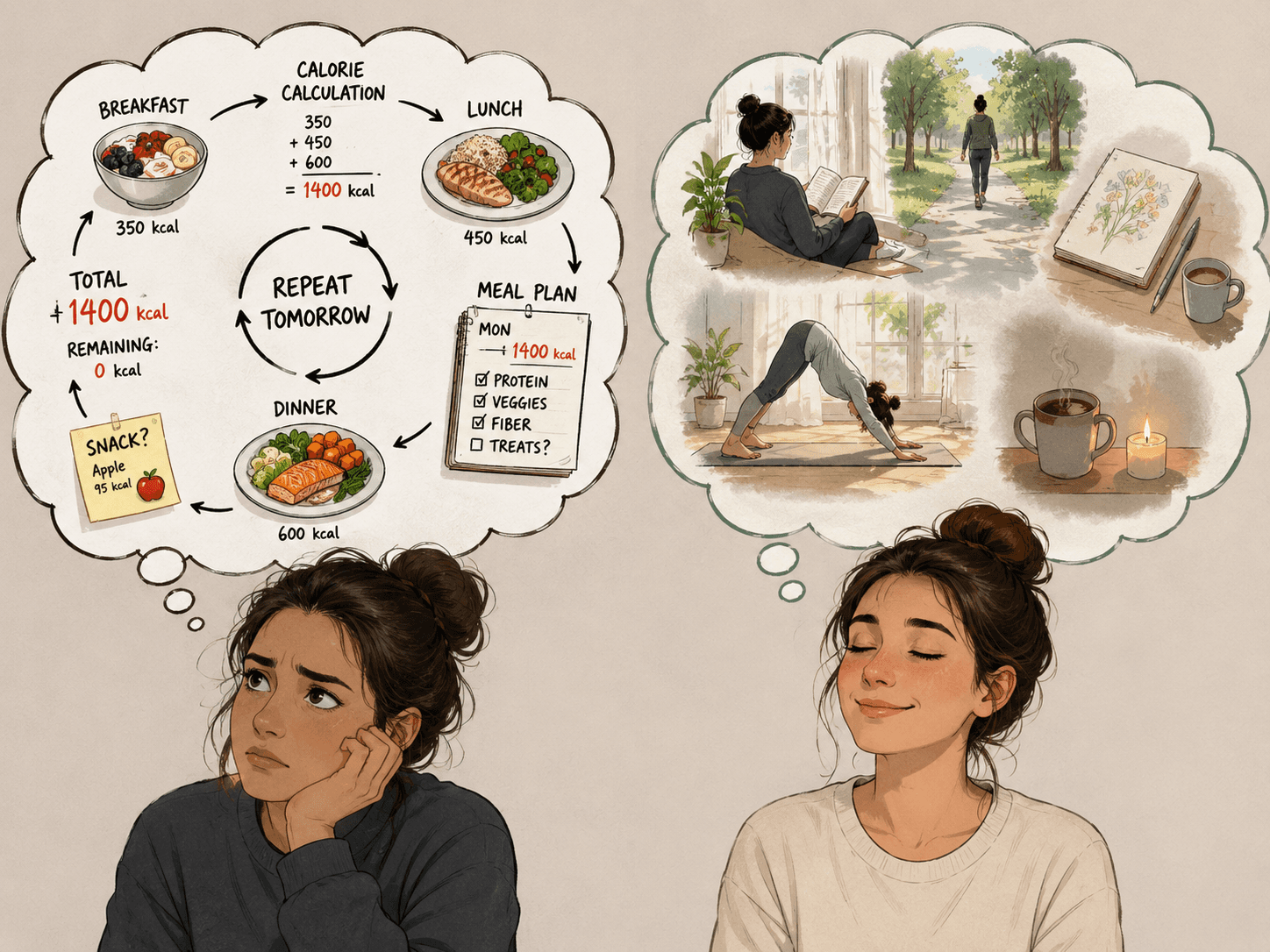
Think of it as your brain's background noise channel running food content on repeat. Thinking about the next meal while still finishing the current one. Checking food delivery apps when you're not hungry. Calculating whether a chocolate bar "fits" before you've even decided to want one. That's the texture of it.
Why food noise is behind so many failed diets
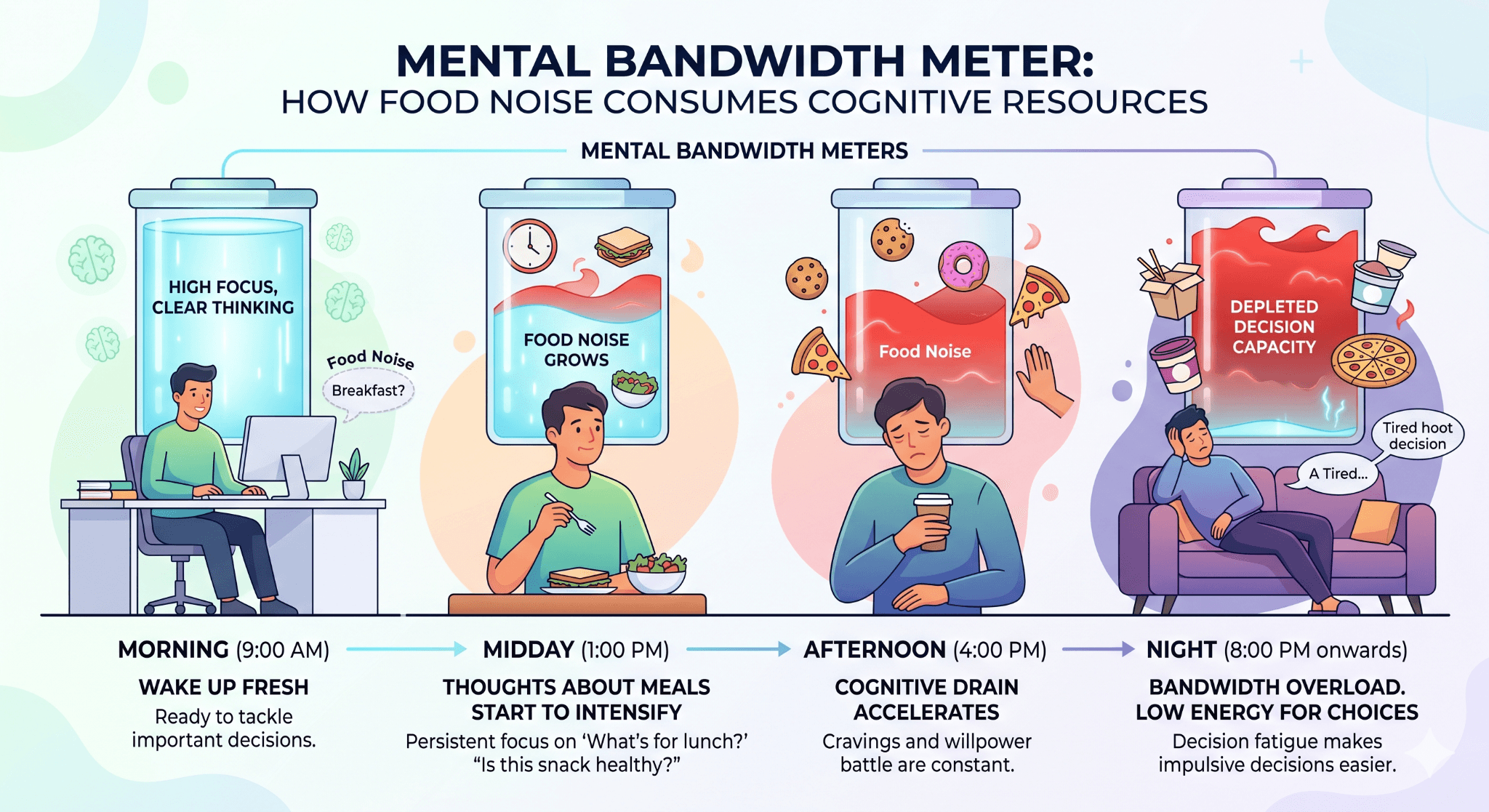
Food noise doesn't just feel uncomfortable. It drains cognitive bandwidth in ways that directly sabotage eating well.
A study by Diktas et al. (2025), which developed and validated the Food Noise Questionnaire, found that higher food noise scores — more frequent and intrusive food thoughts — correlated with a greater tendency to overeat. The association held regardless of body weight or BMI. In other words, it's not just a problem for people actively trying to lose weight. Anyone dealing with persistent food rumination is at higher risk of eating beyond their body's actual signals.
The mechanism is what researchers call cognitive burden: when your working memory is occupied by food-related rumination, there's less mental space for the deliberate, reasoned decisions that healthy eating requires. Decision fatigue sets in faster. Impulse control weakens. By 9pm, your brain has been running the food channel all day. It's exhausted.
This is also why chronic restriction tends to backfire. The more rigidly you police what you eat, the more mental real estate food thoughts occupy. Restriction amplifies food noise, which makes restriction harder to sustain. It's a loop many dieters live inside for years without naming it.
What's causing it in your brain
Food noise has several distinct biological drivers, and they stack.
Ultra-processed foods hijack the reward system
Ultra-processed foods are engineered to combine sugar, fat, and salt at ratios that trigger intense dopamine responses, the same neurotransmitter central to addiction. fMRI data shows these foods activate brain reward centers at intensities comparable to addictive substances. Volunteers shown images of fast food displayed activity in the nucleus accumbens, the same region activated by cocaine and alcohol.
Each exposure strengthens the neural pathway. Over time, the brain doesn't just respond to eating highly palatable foods; it anticipates them, craving them even without physical hunger. Simultaneously, dopamine receptors become less sensitive to whole foods, so the bar for "satisfying" keeps rising. The result is a reward system that's permanently scanning the environment for the next hit.
The Default Mode Network keeps wandering toward food
When you're not focused on a specific task, your brain defaults to a state of mind-wandering called the Default Mode Network (DMN). Research shows we're in this unfocused state roughly 47% of the time. For people with high food noise, the DMN gets stuck in food-related rumination loops, triggered by both internal cues (mild hunger) and external ones (a food ad, a smell, the vending machine at work).
This is why food noise strikes hardest when you're bored, tired, or half-watching TV. Those are peak DMN moments.
Poor sleep turns up the volume
Sleep deprivation raises ghrelin (the hunger hormone) and lowers leptin (the satiety hormone). A 2025 systematic review and meta-analysis confirmed that sleep restriction disrupts both, increasing appetite and cravings, especially for calorie-dense, hyper-palatable foods. Even a single night of poor sleep measurably amplifies food cue reactivity the next day.
If you notice food noise is loudest on Monday morning after a disrupted weekend, this is why.
Chronic dieting raises cortisol and cue sensitivity
Long periods of caloric restriction elevate cortisol, the body's primary stress hormone. Higher cortisol increases both appetite and food cue reactivity, essentially priming your brain to notice and obsess over food in the environment. Ironically, the harder you restrict, the louder the food channel gets.
This is partly why approaches like slowly increasing calories after a deficit can help calm the system. The body stops treating food as a scarce resource to be preoccupied with.
The GLP-1 connection (and what it reveals)
Food noise as a concept didn't go mainstream until people started taking GLP-1 receptor agonist drugs — Ozempic, Wegovy, Mounjaro — for weight loss. Patients kept reporting the same unexpected side effect: the mental chatter about food went quiet. Not just their appetite. The noise.
A 2025 study presented at the European Association for the Study of Diabetes surveyed 550 people taking semaglutide. Before treatment, 62% experienced constant food thoughts throughout the day. After treatment, that number dropped to 16%. The same group reported improved mental health (64%), improved self-confidence (76%), and healthier habits overall (80%).
That's a remarkable result, but the mechanism matters as much as the number. GLP-1 drugs appear to reduce activity in the brain regions that process food-related reward and craving (the insula, amygdala, and nucleus accumbens), essentially dampening the neurological substrate that food noise runs on. A 2025 case study in Nature Medicine confirmed that tirzepatide temporarily suppressed nucleus accumbens activity associated with food preoccupation.
Two caveats worth knowing. First, the drug-related quieting wore off after approximately five months in that case study, suggesting it's not a permanent neurological fix. Second, GLP-1 drugs aren't accessible or appropriate for everyone. That means the more relevant question is: what does this tell us about addressing food noise without medication?
The answer: your body makes its own GLP-1. And several dietary factors directly influence how much of it gets released.
How to reduce food noise without medication
The biological drivers above point toward specific, evidence-based interventions. None of them are flashy. All of them work.
Eat more protein, especially early in the day
Protein is the most satiating macronutrient. A key mechanism: dietary protein stimulates endogenous GLP-1 release from the gut, triggering satiety signals via the same pathway that GLP-1 drugs activate pharmacologically.
The Protein Leverage Hypothesis, developed by researchers Simpson and Raubenheimer, holds that the body continues to signal hunger until its amino acid requirements are met. If protein intake falls short, the brain keeps searching for food, regardless of total calories consumed. Reaching 25–30g of protein in the first meal of the day appears to significantly lower food noise volume for the rest of it.
For practical context on building higher-protein meals without falling into the common marketing traps, see our post on the protein trap: foods that aren't the protein source you think.
Prioritize fiber-rich whole foods
Fiber slows digestion, blunts blood sugar spikes, and critically, stimulates GLP-1 and PYY, both satiety-signaling hormones. A 2023 study of 72 adults found a meaningful link between increasing dietary fiber and reduced hunger-driven eating.
The practical version: vegetables, beans, whole grains, oats, and nuts. Not fiber supplements added to an otherwise ultra-processed diet. The matrix of a whole food matters; isolated fiber doesn't produce the same satiety response.
Protect your sleep
One underestimated lever. A single night of poor sleep can elevate ghrelin and reduce leptin enough to meaningfully increase cravings the following day. Prioritizing 7–9 hours doesn't just help energy: it directly quiets the neurobiological drivers of food noise by keeping hunger hormones in their proper ratio.
Cut ultra-processed foods strategically
This doesn't mean perfection. It means recognizing that regularly eating hyperpalatable foods trains the brain's reward system to demand more stimulation — which feeds the noise. Reducing reliance on these foods progressively allows dopamine receptor sensitivity to normalize over time.
Eat consistently, not restrictively
Irregular meal timing and deliberate skipping amplify food cue reactivity. The brain responds to unpredictable food access by paying more attention to food, a feature from our evolutionary history where scarcity was real. Regular, adequate meals signal safety. The food channel quiets down when your brain stops tracking whether the next meal is coming.
Rigid rules ("I never eat after 7pm") can be just as counterproductive as chaotic eating if they impose restriction your body reads as threat. Structure helps; scarcity mindset doesn't.
Final thoughts
Food noise is real, measurable, and biological. The 2025 research makes this clear in a way that wasn't possible even two years ago. We now have formal definitions, validated measurement tools, and neuroimaging data showing exactly what's happening in the brain.
The GLP-1 story is the most useful illustration: millions of people discovered their intrusive food thoughts weren't a willpower problem when those thoughts vanished on a drug that works via the gut-brain axis. That same axis is accessible through diet, through protein, fiber, sleep, and pulling back from the hyperpalatable foods that hijack it in the first place.
The goal isn't to never think about food. Food is culture, pleasure, and nourishment. The goal is a brain that thinks about food on your terms, not on a loop you didn't choose.