
MD Psychiatry Resident, MBBS
Share this story
Introduction
Running gets romanticized as this magical calorie-torching activity. You see headlines like "Torched 500 calories in 45 minutes!" and feel the pressure to lace up and sprint. But the reality is messier—and genuinely more useful once you understand it.
Here's the thing: the calories you burn running a mile vary wildly depending on body weight, pace, and fitness level. Instead of obsessing over a single number, what if I told you that understanding the drivers of calorie burn is far more practical than chasing an exact figure?
In this post, I'm breaking down the science, sharing realistic numbers, identifying what actually moves the needle, and walking you through proven strategies to maximize calorie expenditure. By the end, you'll understand not just how many calories you're burning, but why and what to do with that knowledge.

How Many Calories Do You Actually Burn Running a Mile?
Let's cut to it: a 155-pound person burns roughly 100 calories running a mile at a moderate pace (around 10-minute mile). But that number is almost useless in isolation.
Here's what the actual range looks like:
125-lb person: ~75-85 calories per mile
155-lb person: ~95-110 calories per mile
185-lb person: ~125-140 calories per mile
220-lb person: ~155-175 calories per mile
The pattern is stark: heavier people burn more calories. This is pure physics—moving more mass requires more energy. A 220-pound runner burns nearly double the calories per mile compared to a 125-pound runner, same pace.
Here's what catches most people off guard: speed matters far less than body weight. Running a mile at 6 mph versus 10 mph shifts calorie burn by only 10-15%. Yes, faster is better, but you're not getting the exponential return marketing suggests.
What about the famous "afterburn effect"? It's real, but modest. EPOC (excess post-exercise oxygen consumption) typically adds 6-15% extra calories post-run. If you burned 100 calories running, expect an extra 10-15 calories in the hours after. Not the game-changer it's marketed as.
The honest translation: Body weight dominates. Everything else speed, fitness level, terrain plays a supporting role.
Track your actual expenditure. Zorest Macro syncs with your running data and pulls your meal logs into context, so you see the real relationship between what you burn and what you eat not guesswork.
What Actually Determines Your Calorie Burn
If you want to maximize calorie expenditure, separate the big levers from the small ones.
Body Weight and Composition
Body weight is the single strongest predictor of calories burned per mile. This creates a feedback loop: heavier bodies burn more calories running; more running makes weight loss easier; lower weight makes each run slightly less efficient calorically, but your overall fitness improves.
Muscle composition adds a second layer. Muscle is metabolically active—it burns calories at rest and during exertion. Two 155-pound people can have different calorie burns depending on their muscle-to-fat ratio. A muscular runner burns slightly more than a sedentary person at identical body weight.
Fitness Level: The Efficiency Paradox
This trips people up: as you get fitter, you become more efficient at running. That sounds backwards. But efficiency means your body accomplishes the same work with less energy expenditure.
A trained runner might burn 15-30% fewer calories per mile than a beginner, at the same pace. This isn't weakness it's improvement. Their cardiovascular system, mitochondria, and running economy have all leveled up. Their body is simply better at the task.
This explains why people hit weight-loss plateaus even though they're running more. They're not failing. They're experiencing metabolic adaptation.
Pace and Intensity
Pace matters, but not as much as conventional wisdom suggests. Running faster burns more total calories per unit of time. But when measured per mile, the difference shrinks dramatically. A 6 mph run burns fewer total calories than a 10 mph run over 30 minutes, but per mile, they're close.
High-intensity interval training is the exception. Sprinting or tempo runs create larger metabolic disruption and elevate calorie burn substantially more than steady jogging.

Age and Metabolism
Metabolic rate declines with age—roughly 3-5% per decade after 30. But in the context of running a mile, age plays a supporting role. A 50-year-old who runs consistently burns calories at a far higher rate than a sedentary 25-year-old.
Terrain and Environmental Conditions
Running uphill, on trails, or into wind increases calorie burn substantially—sometimes 20-40% versus flat ground. Treadmill running is deceptively efficient because there's no wind resistance or ground irregularities.
The Efficiency Trap: Why Getting Fit Can Feel Counterproductive
This is the frustration point for serious runners, so let's be direct.
When you start running consistently, something wonderful happens: you get better at it. Your cardiovascular fitness improves. Your body learns to run with less wasted effort. Your VO2 max climbs.
But here's the downside: as your fitness improves, you burn fewer calories per mile.
This creates a psychological trap. You're running more than ever—maybe 15 miles weekly instead of 5—but the weight loss stalls. You feel stronger and faster. The scale doesn't budge. The culprit isn't laziness or bad luck. It's metabolic adaptation.
A beginner running 3 miles might burn 300 calories. The same person six months later—15 pounds lighter and significantly fitter—might burn only 240 calories for those same 3 miles. Weight loss and efficiency both work against the calorie deficit.
Here's what matters: this is progress, not a problem. The efficiency gains mean you can run faster, farther, or harder without burning proportionally more calories. You've become a superior runner. The frustration comes from expecting running to fuel calorie deficit indefinitely.
The practical implication: Once you reach baseline fitness, relying solely on running for a calorie deficit becomes counterintuitive. You need to increase intensity dramatically, add training variety (strength, HIIT, longer runs), or adjust nutrition to deepen the deficit.
How to Maximize Calorie Burn While Running
If you want to extract maximum calorie expenditure from running, focus on the variables you control. Here's how.
Run at Higher Intensity
High-intensity running burns more calories per minute than steady-state jogging. A 30-minute interval session (sprints with recovery jogs) will outburn 30 minutes of easy running.
The metabolic effect extends beyond the session. High-intensity work creates a larger EPOC response your metabolism stays elevated longer after intense exertion.
Practically: Replace one steady run per week with intervals. Think 5-minute warm-up, then 8 rounds of 90 seconds hard effort + 90 seconds easy recovery, followed by a 5-minute cool-down. That's 30 minutes of serious calorie expenditure.
Build Muscle Outside of Running
Running is excellent for cardiovascular fitness, but it doesn't build muscle. To maximize calorie burn, you need more lean mass. Why? Muscle burns calories at rest. More muscle means a higher baseline metabolism.
Add 2-3 strength sessions weekly. Focus on compound movements squats, deadlifts, push-ups, rows. Even basic bodyweight work transforms your metabolic profile. The muscle you build doesn't just burn calories during strength training; it burns calories 24/7.
This is where Zorest Macro becomes essential. Building muscle requires deliberate protein intake. Zorest Macro's AI Meal Logger instantly tracks protein consumption; the Daily Meal Planner suggests next-day meals aligned with both running and muscle-building goals. You get the nutritional feedback loop that transforms isolated runs into part of a complete body composition strategy.
Increase Running Volume (Carefully)
More miles equal more calories burned. Running 20 miles weekly instead of 10 burns roughly double the calories from running. The trade-off: injury risk scales with volume.
The guideline: increase weekly mileage by no more than 10% per week. Running 10 miles this week? Go to 11 next week, not 15. Your joints, tendons, and connective tissues need time to adapt.
Add Resistance and Terrain
Hills. Trails. Sand. These dramatically multiply calorie burn per unit of effort. A 3-mile hill run might burn 30-50% more calories than 3 flat miles.
Why? Your muscles work harder against gravity and instability. Stabilizer muscles fire harder. You can't coast with momentum or downhill gravity assists.
Practically: Find a local hill or trail and run it once weekly. You'll burn more calories and build substantially greater strength and resilience.
Be Relentlessly Consistent
One great run burns calories. Consistent training shifts your baseline metabolism. When you run 3-4 times weekly over months and years, your aerobic capacity, mitochondrial density, and metabolic efficiency all adapt. The cumulative effect dwarfs any single session.
Consistency also builds the habit loop that makes other health behaviors stick. If you run every Tuesday and Thursday, you're more likely to eat well on those days—the cause-and-effect relationship becomes tangible.
Don't Ignore Nutrition
This is critical: you cannot out-run a poor diet.
One mile burns roughly 100 calories. A handful of almonds wipes that out (160 calories). A coffee drink with extra shots and cream surpasses it (200+ calories).
The most effective fat loss strategy combines calorie deficit from both movement and nutrition. Burn 300 calories running and eat 300 calories less daily—that's a 600-calorie deficit. It works.
Here's the reality: nutrition accounts for roughly 70-80% of fat loss outcomes. Running is the amplifier, not the primary lever.
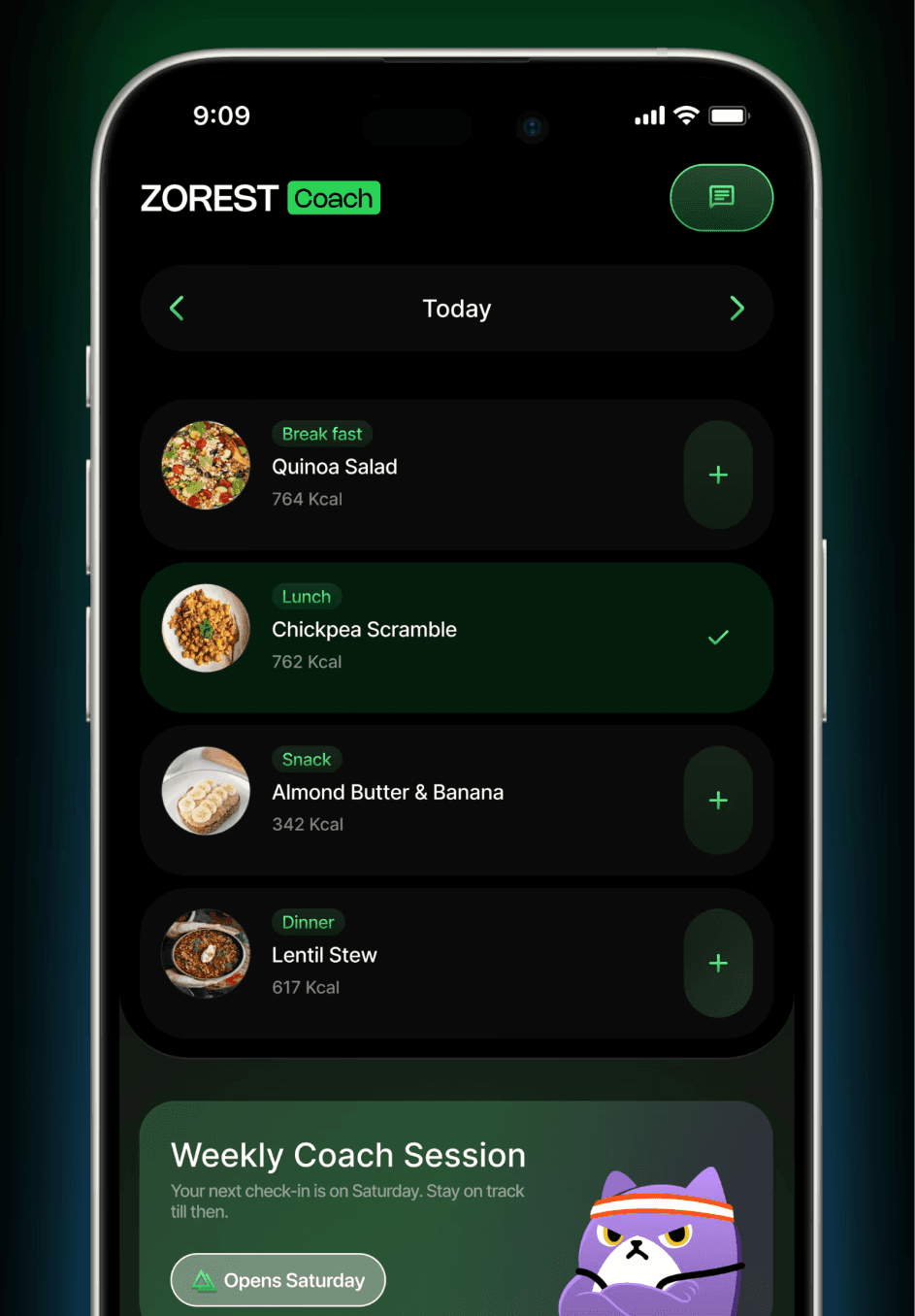
Use Zorest Macro to see exactly where your calories originate. The app's 1.9M-item food database and AI Meal Logger make tracking frictionless. When you see a smoothie bowl is 600 calories versus the same ingredients as a salad is 280 calories, you make smarter choices not because you're "restricting," but because you understand the trade-off.
Beyond Calorie Counting: The Real Reason Running Works
Here's what I want you to understand: obsessing over calories burned per mile misses the actual power.
Running doesn't work because it burns 100 calories. It works because of the systemic effects.
First, running improves metabolic health. It increases insulin sensitivity—your cells respond better to insulin, which means superior blood sugar regulation and less fat storage. It builds mitochondrial density in your muscles, expanding energy capacity and fat-burning potential. These effects compound over months and years.
Second, running builds consistency. The discipline of showing up three times weekly translates to consistency in meal prep, sleep, and stress management. You begin thinking of yourself as "someone who runs," and that identity shifts daily choices.
Third, running strengthens cardiovascular resilience. Your resting heart rate drops. Blood pressure improves. Your heart's pumping efficiency increases. These aren't captured in calorie numbers, but they're foundational to health.
Fourth, the mental effects are real. Running clears your head. It builds confidence. It gives you a tangible challenge where progress is measurable. This psychological win makes everything else easier.
Here's the concrete loop: You run 3 miles, three times weekly (9 miles total). At 100 calories per mile, that's 900 calories from running weekly. Pair that with consistent nutrition tracking via Zorest Macro, and you see the feedback loop in real time. Log your meals. See your calorie and macro intake. Run your miles. Watch how the two practices reinforce each other. Over 12 weeks, that's 10,800 calories from running plus however many you eliminated through better nutrition. The compounding effect is transformative.
The calorie numbers fade. What matters is the identity shift and the systems you've built.
Final Thoughts
A mile burns roughly 100 calories for an average 155-pound person. The number matters less than understanding what drives it. Body weight dominates. Fitness level, pace, and terrain play supporting roles. And here's the key insight: as you get fitter, you become more efficient—meaning per-mile calorie burn decreases even as overall fitness skyrockets.
The real strategy isn't chasing calorie numbers. It's maximizing what you control: intensity, consistency, strength training, and nutrition. Run harder or longer. Build muscle. Eat well. Track your progress.
Don't chase calories burned. Chase performance improvements. Chase the identity of someone who moves regularly and fuels thoughtfully. The calorie deficit will follow.