
MD Psychiatry Resident, MBBS
Share this story
I've been drinking Diet Coke since before I knew what a calorie was. So when July 2023 arrived and every headline screamed "WHO says aspartame causes cancer," I took it personally. Three weeks later, a different WHO panel quietly confirmed the sweetener was still safe at current intake levels. Same month. Contradictory headlines. Same can in my fridge.
If you're sitting with a zero-sugar drink wondering who to believe, that's a reasonable place to be. Both panels were actually right — once you understand what each one was measuring. Here's the real limit math, the real risks, and the nuanced answer the headlines missed.
What's actually sweetening your "zero-sugar" drink
Not all artificial sweeteners are the same compound, and this distinction matters more than most coverage suggests.
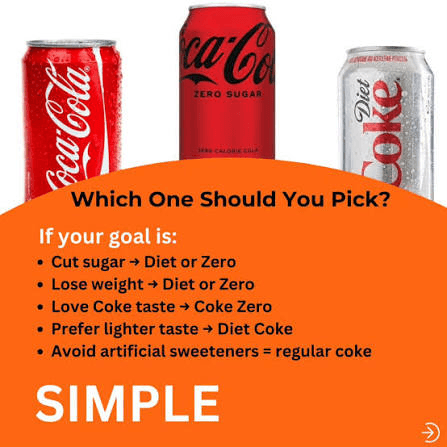
A 12-ounce can of Diet Coke contains roughly 185–200mg of aspartame and some acesulfame potassium (Ace-K). Coke Zero Sugar uses the same two sweeteners. Pepsi Max uses aspartame and Ace-K too. Most "diet" carbonated drinks from major brands are essentially sweetened with this pair.
Then there's a separate category worth keeping distinct: sugar alcohols — erythritol, xylitol, sorbitol, maltitol — which turn up in sugar-free gum, protein bars, "keto" snacks, and some "zero sugar" yogurts. They're chemically different from the sweeteners above and carry their own set of concerns (more on those in a moment).
Finally, you have sucralose (sold as Splenda), which is common in flavored waters and some protein powders, and saccharin (Sweet'N Low), increasingly rare but still used in some tabletop sweetener blends.
Knowing which sweetener you're actually consuming is step one. Most people eat a mix of several without realizing it.
The ADI: your actual daily ceiling
Every approved food additive comes with an Acceptable Daily Intake, or ADI. This is the amount regulators consider safe to consume every day for an entire lifetime — not just occasionally.
The ADI is deliberately conservative. It's set at 1% of the dose that produced no adverse effects in animal studies. That 100-fold safety buffer is baked in by design.
For the sweeteners in your Diet Coke:
Sweetener | ADI (EFSA/JECFA) | ADI (FDA) |
Aspartame | 40 mg/kg body weight | 50 mg/kg body weight |
Acesulfame K | 9 mg/kg body weight | 15 mg/kg body weight |
Sucralose | 5 mg/kg body weight | 5 mg/kg body weight |
Saccharin | 5 mg/kg body weight | 5 mg/kg body weight |
The EFSA (European Food Safety Authority) and JECFA (WHO/FAO's joint expert committee) use the same ADI for aspartame: 40mg per kilogram of body weight per day.
The Diet Coke math
Here's where things get more grounded than the headlines suggest.
A standard 355ml (12oz) can of Diet Coke contains approximately 185–200mg of aspartame. JECFA calculated that an adult weighing 70kg would need to consume more than 9–14 cans of diet soft drink per day — depending on the aspartame level in each can — to exceed the ADI of 40mg/kg body weight.
Using the FDA's slightly more generous limit of 50mg/kg: for a person weighing 150 pounds (68kg), the daily safe threshold is approximately 3,409mg. That works out to roughly 17 twelve-ounce cans of diet soda per day.
So the question "is Diet Coke safe?" becomes: safe at what volume?
One or two cans a day? You're at roughly 10-15% of the lower ADI limit. That's not a meaningful risk by any current safety standard. But at five or six cans, you're entering territory that even Ohio State nutrition researchers flag as "certainly too much" — and above that, the buffer between your intake and the ADI shrinks fast.
The math on Ace-K is even more comfortable — you'd hit the EFSA limit before you'd hit the aspartame ceiling, but at typical soda consumption levels, neither is in serious territory.
The realistic concern is not a single daily Diet Coke. It's the accumulation across multiple products — a morning protein shake sweetened with sucralose, a flavored sparkling water at lunch, two Diet Cokes in the afternoon, a sugar-free dessert at night. The ADI is a cumulative ceiling, not a per-product one.
The "possibly carcinogenic" label, translated
In July 2023, the International Agency for Research on Cancer (IARC) classified aspartame as Group 2B: possibly carcinogenic to humans. The headlines wrote themselves.
What most headlines buried: on the same day, JECFA — the WHO's own food safety committee — concluded that the data evaluated indicated no sufficient reason to change the previously established ADI of 0–40mg/kg body weight for aspartame, reaffirming that it is safe to consume within this limit.
These two findings are not contradictory. IARC classifies hazard — whether a substance has any biological mechanism by which it could cause cancer under any conditions. JECFA assesses risk — whether it actually causes harm at levels humans realistically consume.
Group 2B, IARC's classification, includes pickled vegetables, aloe vera extract, and talc-based body powder. The classification means "limited evidence" exists — not "this will give you cancer." Following the WHO announcement, the FDA issued a statement disagreeing with IARC's classification, emphasizing that its own experts had extensively studied aspartame and raised no safety concerns under approved conditions.
The honest summary: the carcinogen classification is a signal to researchers to keep studying aspartame, not a signal for consumers to panic. At typical consumption levels, current regulatory bodies worldwide continue to consider it safe.
Three concerns that stay real even within safe limits
Being within the ADI doesn't mean the conversation is over. There are three ongoing areas of evidence worth knowing about — not because they demand you stop drinking Diet Coke, but because they should inform how heavily you lean on these products.
1. Gut microbiome disruption
This is where the research is most consistent and most interesting. A 2022 randomized controlled trial by Suez and colleagues showed that while all tested non-nutritive sweeteners altered the gut microbiome, sucralose and saccharin specifically and significantly impaired glycemic responses — effects that were reproduced in germ-free mice colonized with microbiota from exposed individuals.
A 2025 study examining five artificial sweeteners found that synthetic sweeteners like sucralose and saccharin significantly reduced microbial diversity, while non-synthetic sweeteners — particularly stevia-derived rebaudioside A and xylitol — were less disruptive. Sucralose specifically enriched pathogenic bacterial families like Enterobacteriaceae, whereas natural sweeteners promoted beneficial taxa like Lachnospiraceae.
The caveat: most microbiome studies are short-term, conducted in small populations or animals, and the clinical significance for healthy adults consuming typical amounts is still unclear. But if you already have gut health concerns — IBS, inflammatory bowel issues, recurring bloating — this is a reason to tread carefully. Sugar alcohols in particular are well-documented IBS triggers; they're the "P" (polyols) in the FODMAP framework.
2. The weight loss paradox
There's a frustrating irony buried in the research. WHO's systematic review, published in May 2023, found that use of non-sugar sweeteners does not confer any long-term benefit in reducing body fat in adults or children. The review also found potential undesirable effects from long-term use, including increased risk of type 2 diabetes and cardiovascular disease in adults.
The WHO recommendation is conditional and based on evidence of overall low certainty, which matters when interpreting these findings. What the data do consistently suggest is that sweeteners alone don't fix the calorie equation — and some people compensate by eating more elsewhere, reasoning that their "saved" calories buy them a larger meal. If that behavior pattern applies to you, the Diet Coke isn't doing the job you hired it to do.
3. Sugar alcohol GI effects
This one is the most immediate and the most underappreciated. Sugar alcohols — the sweeteners in most "sugar-free" gum, protein bars, and keto snacks — pull water into the large intestine via osmosis. That process, useful for avoiding tooth decay, causes bloating, gas, and diarrhea in a substantial number of people, often at doses as low as 10–15g of sorbitol.
The labels are not always obvious. "Sugar-free" does not mean "sweetener-free." Maltitol, commonly used in sugar-free chocolate, has a significant laxative effect per serving and is one of the more common culprits in the "why does my stomach hurt after eating keto candy" category.
Who genuinely needs to be more careful
For most healthy adults, moderate use of artificially sweetened products — a can or two of Diet Coke per day, occasional sugar-free gum, a protein bar — doesn't approach the ADI for any approved sweetener and carries no established danger.
But several groups should apply extra caution:
People with phenylketonuria (PKU). Aspartame breaks down into phenylalanine during digestion. People with PKU can't metabolize phenylalanine properly, and accumulation causes neurological damage. People with PKU should avoid all aspartame, even at amounts below the ADI. This is why every product containing aspartame carries the "Contains Phenylalanine" warning — it's not a warning for the general population; it's specifically targeted at this group.
People with IBS or sensitive guts. Artificial sweeteners, especially sugar alcohols and sucralose, are known GI irritants. Sugar alcohols are the "P" (polyols) in the FODMAP framework, and one stick of sorbitol-sweetened gum can trigger a flare in sensitive individuals. Sucralose has also shown gut microbiome disruption effects in controlled trials.
Pregnant women. There is little evidence to support the use of or avoidance of sugar substitutes during pregnancy. FDA-approved sweeteners are considered fine to use in moderation, though the American Medical Association advises avoiding saccharin during pregnancy due to possible slow fetal clearance. On the precautionary principle, keeping intake low during pregnancy is sensible even where no direct harm has been established.
People managing blood sugar. The WHO's guidance specifically excludes people with existing diabetes from its recommendation to avoid sweeteners — for them, the sugar-sugar alternative trade-off is still a net positive. But the microbiome and glycemic response data are worth discussing with a doctor if you're using sweeteners very heavily as a diabetes management tool.
The WHO's bigger point, which got buried
The IARC "possibly carcinogenic" story dominated 2023 coverage. The more practically useful message came from a different WHO report, released two months earlier, that barely made the news cycle.
WHO's 2023 guideline recommends against the use of non-sugar sweeteners to control body weight or reduce the risk of noncommunicable diseases, based on findings suggesting that sweeteners do not confer any long-term benefit in reducing body fat.
WHO's Director for Nutrition and Food, Francesco Branca, summed it up directly: "Replacing free sugars with NSS does not help with weight control in the long term. People need to consider other ways to reduce free sugars intake, such as consuming food with naturally occurring sugars, like fruit, or unsweetened food and beverages."
This is the genuinely inconvenient finding. Not that one Diet Coke will harm you — it won't. But building your dietary strategy around artificial sweeteners as a long-term calorie management tool is, by the best current evidence, not as effective as it seems. The fizzy zero-calorie drink doesn't automatically make your overall diet better.
Final thoughts
The safety floor for artificial sweeteners — as set by the ADI — is far higher than almost anyone reaches by drinking a couple of Diet Cokes a day. That part of the panic is not warranted.
But "not dangerous at current intakes" and "something you should lean on heavily for years" are two different conclusions, and the evidence only clearly supports the first one.
The practical middle ground: if a Diet Coke makes it easier for you to skip a 150-calorie regular soda, that's a sensible swap. If you're drinking six a day and also eating three sugar-free protein bars and a pack of sugar-free gum, you're stacking sweeteners across multiple products in ways that add up — and that your gut microbiome may not thank you for long-term.
Use them as a bridge, not as the whole structure. And if your goal is genuinely reducing your overall dependence on sweet flavor — which is the harder, slower, more effective strategy — the research consistently points to sparkling water, herbal tea, and learning to like food that tastes a bit less sweet as more durable long-term answers.