
طبيبة مقيمة في الطب النفسي، MD، MBBS
شارك هذه القصة
You ate a chickpea quinoa salad. Perfectly clean, perfectly healthy. And two hours later, you're bloated and uncomfortable with no idea why. You cut out dairy. Then gluten. Then legumes. You're eating less and less, yet your gut still flares unpredictably.
The problem has never been effort. It's been information. Most people manage gut issues reactively: eat something, feel terrible, try to remember what they had. Zorest Macro works the other way. It tells you how a meal is likely to affect your gut before you eat it, then logs every symptom when it doesn't go to plan.
Here's how the gut-specific features work.
Why gut symptoms are so hard to track on your own
Gut reactions are delayed. Symptoms can appear 30 minutes to three hours after eating, which means most people blame the wrong meal entirely. You might point the finger at Tuesday's lunch when the real trigger was the garlic in Tuesday morning's breakfast scramble.
Even when people try to keep food diaries, they miss the small additions that matter most. A splash of oat milk here. A garlic-heavy dressing there. A few dates as an afternoon snack. These carry significant fermentable carbohydrate loads. And they're also the items most likely to disappear from memory by the time symptoms hit.
A 2023 real-world study of 21,462 participants using a low-FODMAP tracking app found that structured food logging led to measurable reductions in bloating, abdominal pain, and flatulence. The insight wasn't magic. It was data, collected consistently enough to see patterns.
Zorest Macro's gut features are built on this exact logic: systematic logging plus AI prediction equals patterns you can actually act on.
The Gut Issue Logger: your symptom record, built over time
The first layer of Zorest Macro's gut system is the Gut Issue Logger. When you experience a gut symptom, you log it directly: choose from bloating, gas, diarrhea, acid reflux, and more, rate severity on a scale, and
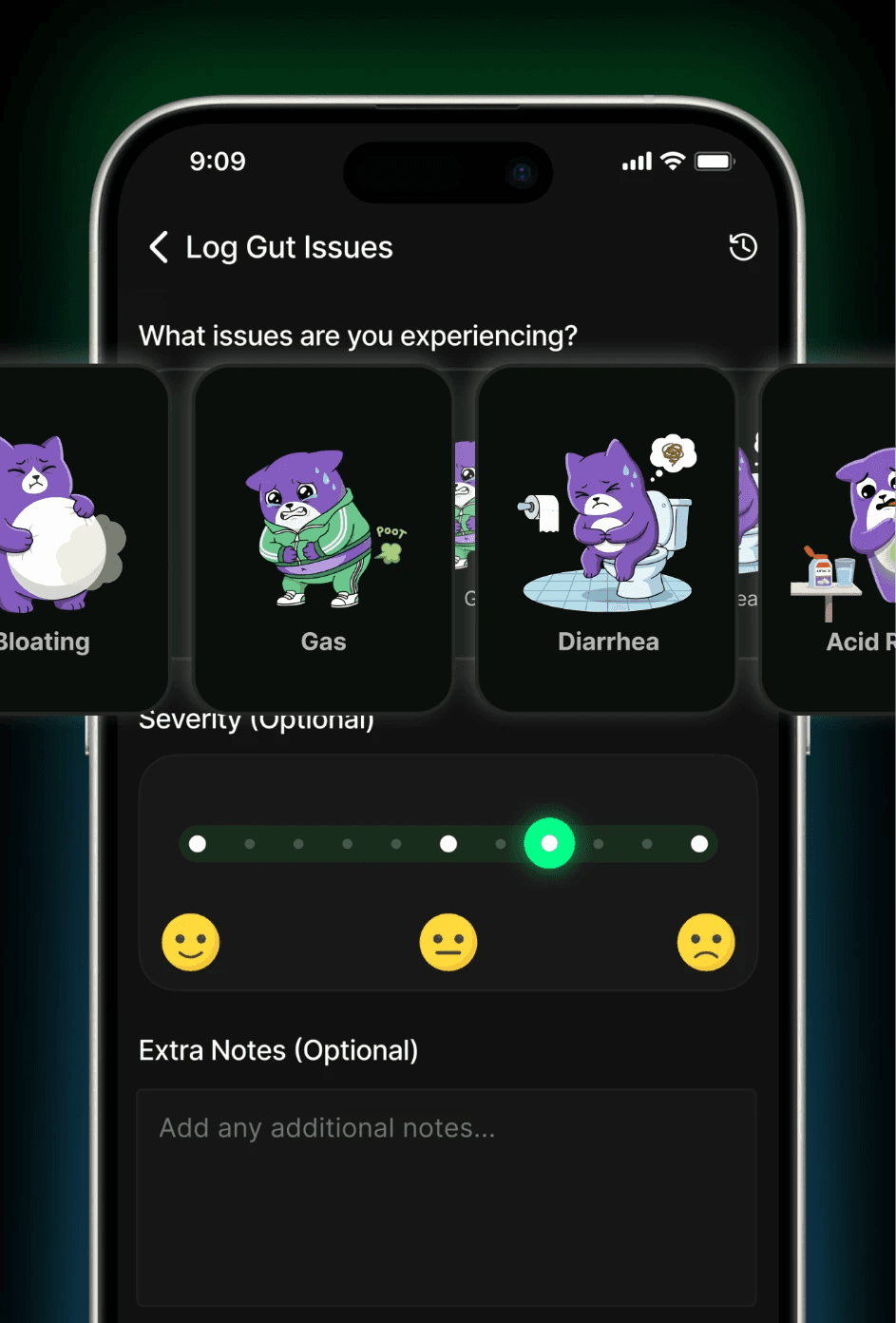
add any extra notes.
I'll be honest: the first time I used this, it felt like overkill. Who's going to log their bloating in an app? But the reason it matters becomes clear a few weeks in. Each log is timestamped and tied to your meal history. That data is what allows the AI to identify which foods consistently precede which symptoms for you specifically, not just what research says happens on average.
This is also useful when talking to a doctor or gastroenterologist. Instead of "I've been bloated a lot lately," you can pull up a concrete record: what you ate, when symptoms appeared, how severe they were, and how often this pattern repeats. That's a different category of clinical conversation.
If you have a diagnosed condition and want to understand which foods are doing the most damage, our IBS trigger foods guide covers the five categories that show up most consistently across gut-sensitive people.
The FODMAP Score: know your safe serving limit before you eat
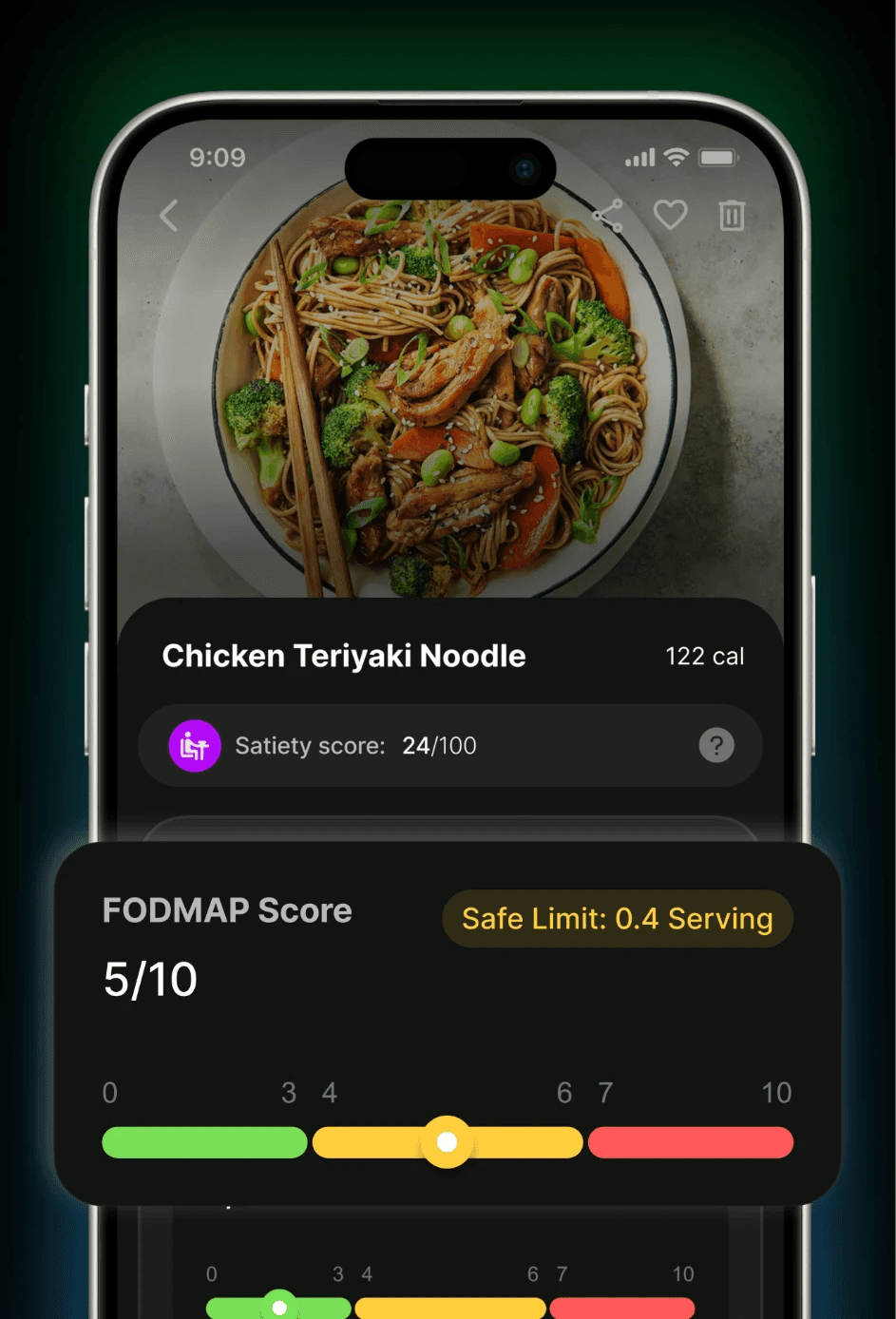
Every food in Zorest Macro carries a FODMAP Score from 0 to 10, displayed on a color-coded green-to-red scale. More usefully, it shows you the safe serving limit: the portion at which that food stays within a tolerable FODMAP threshold.
[Screenshot: Zorest Macro's FODMAP Score display for Chicken Teriyaki Noodle — showing a score of 5/10 on a green-yellow-red gradient bar, with "Safe Limit: 0.4 Serving" highlighted in a yellow tag.]
Take the Chicken Teriyaki Noodle example in the app: FODMAP Score of 5/10, safe at 0.4 of a serving. That's a number most people would never calculate on their own, and it changes how you think about portion control for gut-sensitive foods.
This matters because FODMAP sensitivity is dose-dependent. Many foods that trigger symptoms at a full portion are perfectly tolerable at a smaller one. Onion is a classic example: a small amount cooked into a dish may clear your threshold, while half an onion raw in a salad pushes you firmly into the red. Without a score like this, the same food feels randomly safe or random dangerous, and you end up cutting things out unnecessarily.
The FODMAP Score is visible for every food you log or search in the app, which means you can check it before you eat, not after. That's a different kind of tool than a food diary you fill in retrospectively.
For people managing SIBO alongside general gut sensitivity, the SIBO diet guide covers how FODMAP thresholds interact with the specific dietary management approaches for bacterial overgrowth. The overlap is significant, but so are the differences.
The Gut Health Score: a single number for how gut-friendly a food is
Each food in Zorest Macro also carries an overall Gut Health Score out of 100. This is a composite measure of how beneficial (or not) a food is for digestive health, accounting for its fiber profile, FODMAP load, fermentability, and other relevant factors.
A Chickpea Quinoa Salad scores 88/100. That's a high gut health score: the food is nutritious and fiber-rich, which is useful context. But scroll down to the AI prediction layer and the picture gets more nuanced.
The Gut Health Score is most useful as a quick reference when you're building a meal or comparing two food options. If you're logging a meal plan and one dish scores 40/100 while a comparable alternative scores 75/100, that gap is informative without requiring you to understand every individual variable behind it.
AI gut prediction: the symptom forecast before you eat
This is the feature I find most striking. For each food, Zorest Macro's AI shows you predicted probabilities for specific gut symptoms: what percentage chance you have of experiencing bloating, gas, indigestion, or acid reflux if you eat that meal.
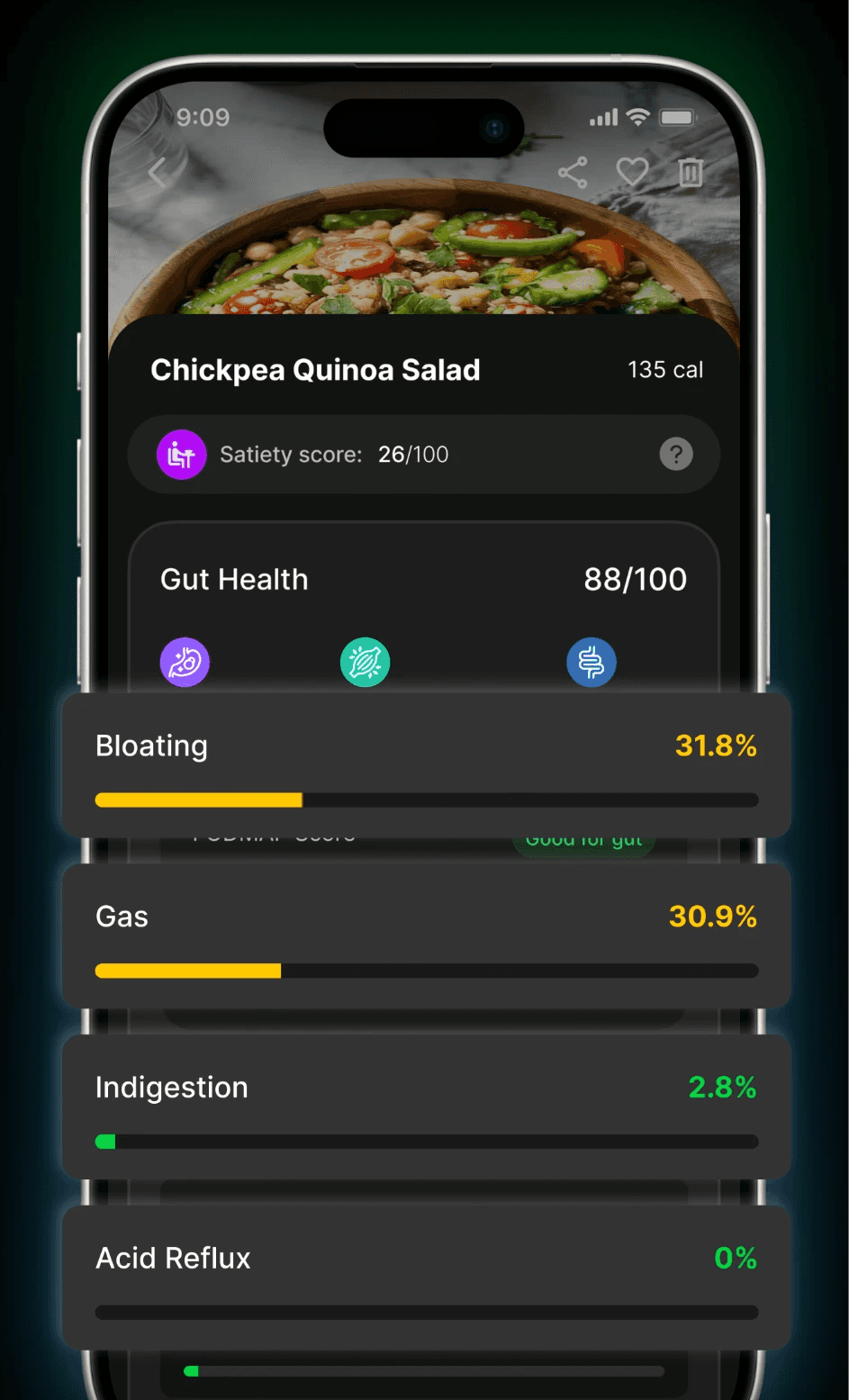
The chickpea quinoa salad example shows bloating at 31.8% and gas at 30.9%. The acid reflux risk is 0%. This is not a generic FODMAP warning. It's a food-specific prediction of which symptoms you're most likely to experience, expressed as a percentage.
What makes this more than a curiosity is that these predictions are built on the pattern your own logs create over time. The more consistently you log your meals and gut symptoms, the more the AI can personalize these predictions beyond population averages. If you've never had trouble with chickpeas, your personal prediction score will reflect that. If chickpeas reliably cause problems for you, the model learns that too.
This turns a reactive process (eat → feel bad → try to remember → guess at trigger) into a proactive one (see risk before eating → choose portion size or alternative → track what happens). For anyone who has spent months doing elimination diets by trial and error, the difference in efficiency is real.
The gut-brain connection is also worth understanding here: gut distress rarely stays in the gut. If the gut-brain axis is new to you, it's worth reading before you dismiss a gut symptom as "just digestive." The science behind why a 31% bloating risk might also translate into afternoon brain fog or low mood is more direct than most people expect.
How the four features work as a system
The gut features in Zorest Macro aren't four separate tools. They're a loop.
You log a meal. The app shows you the FODMAP Score and safe serving limit before you eat. After the meal, you check your Gut Health Score for context on how nutrient-dense and gut-supportive that food actually is. If symptoms appear, you log them in the Gut Issue Logger with severity. Over time, the AI prediction layer gets sharper, because it has your real symptom data, not just population averages.
The Restaurant Menu Analyzer extends this to eating out. Snap the menu, get a nutritional breakdown, and make a call on which dish is least likely to set off your gut before you order. It's the same system applied to the one situation where you normally have the least control over your ingredients.
None of this replaces a gastroenterologist if you have a diagnosed condition. But it gives you a clearer picture of your own gut than any method that relies on memory and estimation.
Final thoughts
Gut symptoms stop feeling random when you have enough data to see the pattern. Zorest Macro's gut features (the Gut Issue Logger, FODMAP Score with safe serving limits, Gut Health Score, and AI symptom predictions) are designed to build that picture faster than any paper diary or elimination guessing game could.
The goal isn't to make you anxious about every meal. It's to give you enough information to make one or two better decisions per day. Over weeks, that compounds into a significantly calmer gut.
Got questions? Ping me on LinkedIn.