
طبيبة مقيمة في الطب النفسي، MD، MBBS
شارك هذه القصة
You've heard it before: eat well, feel better. But most people picture that as a vague lifestyle tip — the kind you nod at and ignore. Here's what they don't tell you: the link between what you eat and how you feel isn't motivational. It's anatomical. Your gut and your brain are physically wired together, and that connection runs deeper than anyone thought twenty years ago.
If you've ever lost your appetite before a stressful presentation, felt your stomach drop at bad news, or noticed your mood tank after a week of poor eating — that wasn't coincidence. That was your gut-brain axis doing exactly what it's designed to do.
Your gut has its own nervous system
The gut-brain connection starts with a surprising fact: your gut contains more than 100 million nerve cells, forming what scientists call the enteric nervous system (ENS). It's so complex and so functionally independent that neuroscientists gave it a nickname — the "second brain."
The ENS lines your entire gastrointestinal tract from esophagus to rectum. It doesn't write poetry or solve algebra problems, but it does regulate digestion, coordinate muscle contractions, control blood flow, and respond to emotional input — all without any instruction from the brain in your skull.

What makes this remarkable is that the ENS shares neurotransmitters with the central nervous system. Serotonin, dopamine, GABA — the same chemicals that regulate your mood up top are produced and used in your gut. In fact, roughly 90–95% of the body's serotonin is produced in the gut, not the brain.
That detail rewrites the standard story about mood regulation. The chemicals we associate with happiness, calm, and clarity aren't primarily brain chemicals. They start downstairs.
How the gut and brain talk to each other
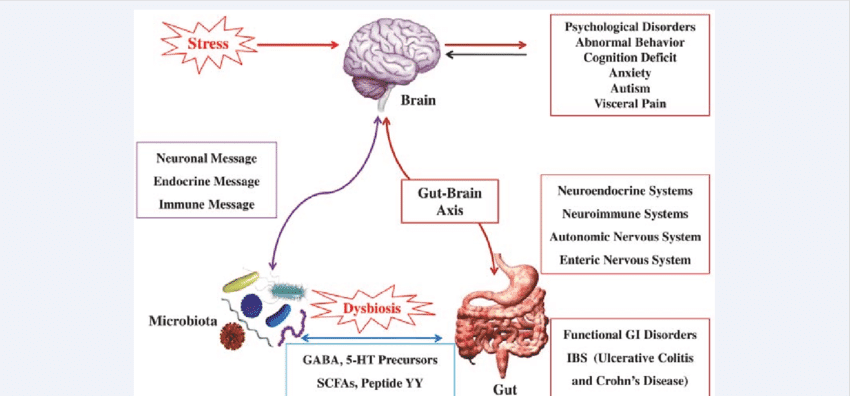
The gut-brain axis operates through four overlapping channels:
The vagus nerve. This is the main highway. The vagus nerve is a long cranial nerve that runs from the brainstem all the way down to the colon. It acts as the central conduit for peripheral signals from the gut to the central nervous system, carrying information in both directions. Importantly, about 80–90% of vagal fibers run upward — from gut to brain — not the other way around. Your gut is sending far more information to your brain than your brain sends back.
Neurotransmitter production. The gut microbiome — the trillions of bacteria living in your intestinal tract — produces or regulates several key brain chemicals. Lactobacillus and Bifidobacterium strains produce GABA. Gut bacteria influence serotonin synthesis. Short-chain fatty acids (SCFAs) produced by fiber-fermenting bacteria act on vagal receptors and modulate mood-regulating neurons in the brainstem.
The immune system. About 70% of your immune cells live in or around your gut. When gut bacteria are imbalanced (a state called dysbiosis), the intestinal lining becomes more permeable — sometimes called "leaky gut" — and inflammatory compounds enter the bloodstream. Research consistently links this systemic inflammation to depression, anxiety, and cognitive impairment.
Hormones and stress signals. The hypothalamic-pituitary-adrenal (HPA) axis — your stress response system — is regulated in part by gut microbiota. When the microbiome is disrupted, cortisol regulation can break down, leaving you in a state of low-grade chronic stress even when nothing is acutely wrong.
When stress hits the gut
Here's where it gets circular — and frustrating if you've lived it.
Stress and anxiety trigger the brain to activate the "fight-or-flight" response. That response, via the autonomic nervous system, hits the gut hard: it slows gastric emptying (that knot-in-your-stomach feeling), accelerates colonic transit (stress-induced urgency or diarrhea), and ramps up visceral sensitivity, meaning you feel gut sensations more acutely and painfully than normal.
Research shows that people with IBS have significantly higher rates of anxiety disorders than the general population — not because one causes the other in a clean linear way, but because they reinforce each other in a loop. Stress worsens gut symptoms. Gut symptoms drive anticipatory anxiety. That anxiety worsens gut symptoms again.
This bidirectional loop is why IBS is now classified by researchers as a disorder of gut-brain interaction (DGBI) rather than a purely digestive condition. If you're managing it through diet alone and still struggling, understanding the gut-brain axis might be the missing piece.
Depression follows a similar pattern. A 2025 review in Frontiers in Microbiomes found that patients with major depressive disorder show dysregulated bile acids, altered amino acid derivatives, and changes in specific microbial genera — suggesting that gut dysbiosis and depression pathophysiology are metabolically intertwined, not just correlated.
What a disrupted gut-brain axis looks like
The signs aren't always obvious. Most people assume mental health is a brain problem and gut health is a digestion problem. But altered microbial diversity, decreased SCFA production, and increased neuroinflammation all contribute to mental health disturbances — including anxiety, depression, and brain fog that don't respond to typical interventions.
A few patterns worth recognizing:
Chronic bloating or irregular digestion that worsens during stressful periods
Mood dips that follow a stretch of poor eating (processed foods, alcohol, minimal fiber)
Digestive symptoms that improve during calm periods or holidays — despite no dietary change
Persistent low-grade anxiety that doesn't have an obvious trigger
None of these are proof of a gut-brain problem on their own. But together, they signal that the two systems may be talking badly.
What the research says about Parkinson's and long COVID
The gut-brain link isn't limited to mood. The most striking evidence comes from neurodegenerative research.
In Parkinson's disease, gut issues like constipation and heartburn appear years — sometimes decades — before motor symptoms. Researchers have identified differences in gut microbiome composition in Parkinson's patients, and a 2024 Harvard study found that damage to the upper digestive tract significantly increases the risk of developing Parkinson's later in life.
Long COVID adds another data point. A 2023 Stanford study found that long COVID is associated with reduced serotonin in the body — serotonin that originates in the gut. In animal models mimicking long COVID, vagus nerve activity was reduced, and the animals developed memory and cognitive deficits similar to those seen in humans.
These aren't fringe findings. They're published in top journals, and they point to one consistent conclusion: gut health is brain health.
What actually supports the gut-brain axis
The science here is more nuanced than "eat yogurt and feel great." But a few dietary patterns have solid evidence behind them.
Fiber. Dietary fiber feeds the bacteria that produce SCFAs — particularly butyrate, which strengthens the intestinal barrier, reduces neuroinflammation, and modulates vagal signaling. Aim for a range of fiber sources: oats, legumes, vegetables, whole grains. Diversity matters more than total quantity.
Fermented foods. Fermented foods increase microbiome diversity and reduce markers of inflammation. A landmark 2021 Stanford RCT found that a high-fermented-food diet outperformed a high-fiber diet for increasing microbial diversity. Yogurt, kefir, kimchi, sauerkraut, and kombucha are all usable here — preferably with live cultures.
Omega-3 fatty acids. Consuming omega-3-rich foods helps maintain microbial balance and supports the production of beneficial metabolites. Fatty fish, walnuts, and flaxseed are practical sources.
Prebiotic foods. Garlic, onions, leeks, asparagus, and bananas feed beneficial bacteria. These are the same foods that can be problematic for people with IBS (specifically high-FODMAP eaters), which is one reason gut-brain management often requires personalization rather than a blanket approach.
Ultra-processed food — what to limit. A 2024 umbrella review confirmed a dose-response relationship between ultra-processed food intake and risk of common mental disorders. The mechanism runs through the microbiome: emulsifiers, artificial sweeteners, and low-fiber processed ingredients all disrupt microbial composition and increase intestinal permeability.

The probiotics question
Probiotics get oversold. I've seen enough supplement marketing to be skeptical, and the clinical picture justifies that skepticism.
Probiotic supplementation can improve emotional well-being, but its efficacy depends on strain specificity, dosage, and baseline microbiome composition. In plain terms: the yogurt aisle and the supplement shelf aren't interchangeable, and a Lactobacillus blend that works for one person may do nothing for another.
That said, a comprehensive review of studies through 2024 found that alterations in gut microbiome composition are consistently present in individuals with depression, schizophrenia, ADHD, and autism — and that probiotic supplementation shows meaningful positive effects in some of those populations. The research is promising. It just isn't yet precise enough to write universal dosing recommendations.
The practical position: prioritize fermented and prebiotic foods before reaching for supplements. If you do supplement, look for multi-strain products with Lactobacillus and Bifidobacterium species that have published RCT evidence behind them.
What damages the gut-brain axis
Some culprits are obvious, some aren't:
Chronic stress — sustained cortisol dysregulates the HPA axis and reduces microbial diversity
Ultra-processed foods — disrupt microbial composition and increase intestinal permeability
Antibiotics — can wipe out beneficial bacteria; the neuropsychiatric effects of this disruption are an active research area, especially for antibiotics used during infancy and childhood
Poor sleep — the gut operates on circadian rhythms; disrupted sleep schedules compromise both microbial balance and vagal tone
Sedentary lifestyle — regular physical activity stimulates gut motility and benefits mood through ENS-CNS signaling
None of these is a revelation. But seeing them as gut-brain threats — rather than just "lifestyle" issues — makes the stakes clearer.
Final thoughts
The gut-brain connection isn't a wellness metaphor. It's a physical, chemical, bidirectional communication system that runs 24/7. Your microbiome produces the precursors to your mood chemicals. Your vagus nerve reports gut status to your brain constantly. Stress reshapes your gut lining. And what you eat restructures the bacterial population that drives all of it.
That doesn't mean fixing your gut will cure depression, reverse anxiety, or protect you from Parkinson's. The science isn't there yet, and anyone telling you otherwise is selling something.
What it does mean: gut health and mental health are not separate categories. Treating them as if they were — optimizing your diet for digestion while ignoring mental health, or chasing therapy while eating nothing but processed food — leaves half the system unaddressed.
Feed the whole system. It's all connected.