
MD Psychiatry Resident, MBBS
Share this story
Introduction
Every gym has someone who asks the same question: "What's the world record bench press?"
It's a fair question. Watching someone press 100 kg is impressive. Watching an elite powerlifter press more than three times that amount seems almost unbelievable.
But the answer isn't as simple as one number.
Bench press records vary depending on whether the lift is performed raw (without a supportive bench shirt) or equipped (using specialized supportive gear). Men's and women's records are also tracked separately, and different powerlifting federations maintain their own record books.
In this guide, I'll explain the biggest bench press records ever achieved, how they're measured, and what they tell us about the limits of human strength.

What is the world record bench press?
The current all-time world record depends on the category being discussed.
For official competition lifts:
Category | Athlete | Record |
Raw men's bench press | Julius Maddox | 355 kg (782.6 lb) |
Equipped men's bench press | Jimmy Kolb | 635 kg (1,401 lb) |
Raw women's bench press | April Mathis | 207.5 kg (457.5 lb) |
Equipped women's bench press | Ashleigh Hoeta | 317.5 kg (700 lb) |
These numbers represent officially recognized competition lifts under powerlifting rules. Different federations recognize different records, but these performances are widely regarded as the highest all-time marks.
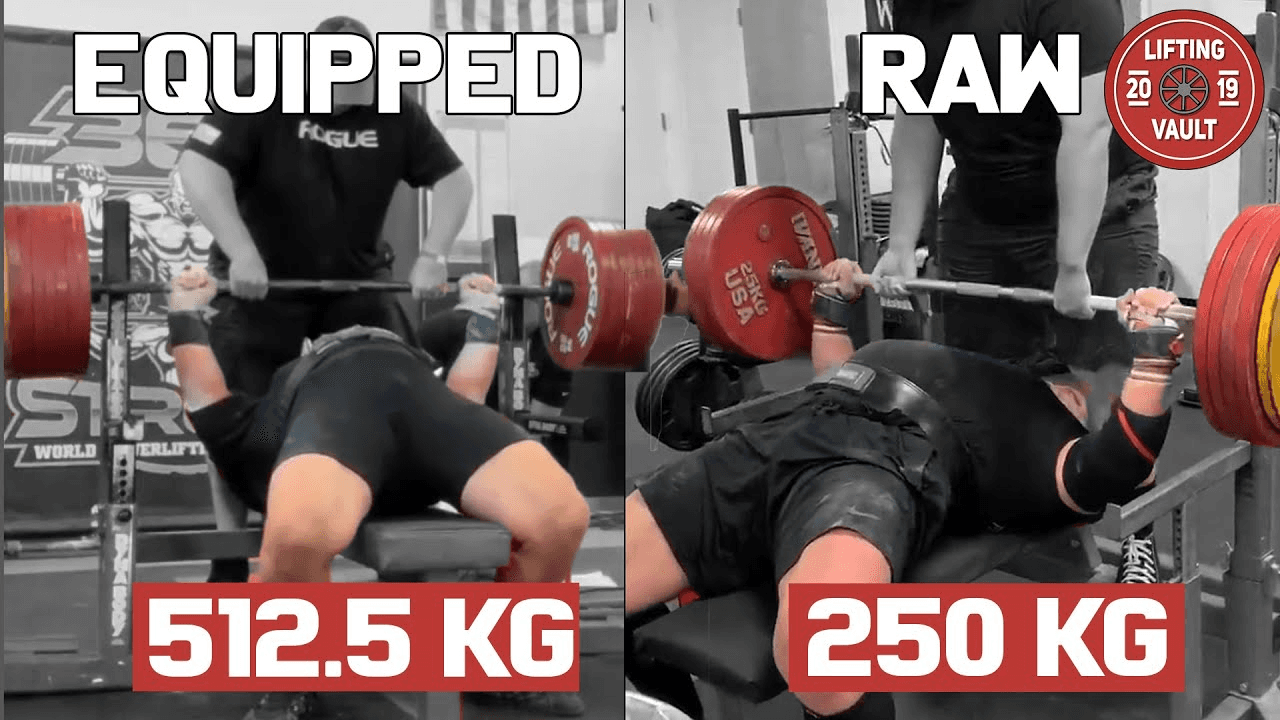
The enormous gap between raw and equipped records exists because a bench shirt stores elastic energy and provides mechanical assistance during the lift.
Why there isn't just one bench press world record
The biggest misconception is assuming there's a single universal bench press record.
There isn't.
Powerlifting divides records into several categories.
Raw bench press
Raw lifting allows only minimal supportive equipment such as:
Wrist wraps
Belt (depending on federation)
Standard singlet
No bench shirt is allowed.
Because the athlete relies almost entirely on muscular strength, raw records receive the most public attention.
Equipped bench press
Equipped lifting uses a specialized bench shirt.
These shirts are made from extremely stiff materials that compress the shoulders and chest during the descent. As the bar reaches the bottom, the shirt stores energy and helps launch the bar upward.
Learning to use a bench shirt can take years, and lifting with one requires different technique.
This explains why equipped records can exceed raw records by hundreds of kilograms.
Julius Maddox: The king of the raw bench press
When people ask about the world record bench press, they're usually referring to Julius Maddox.
The American powerlifter officially bench pressed 355 kilograms (782.6 pounds) raw in competition, making him the strongest raw bench presser in history.
His rise has been remarkable.
Before Maddox, athletes such as:
James Henderson
Scot Mendelson
Kirill Sarychev
Eric Spoto
held or challenged raw bench press records.
Maddox pushed the ceiling even higher by becoming the first athlete to officially break the 350 kg barrier.
His training is equally legendary.
Videos of him pressing over 700 pounds for multiple repetitions have become some of the most viewed strength clips online.
Jimmy Kolb owns the equipped bench press record
The largest official bench press ever completed belongs to Jimmy Kolb.
Using multi-ply bench equipment, he successfully pressed:
635 kilograms (1,401 pounds)
at the 2023 IPA Tristar Bash.
That's nearly the weight of a small family car.
While equipped lifting often sparks debate among casual gym-goers, it's still an incredibly technical discipline requiring years of practice and extraordinary strength.
World record bench press female
Women's bench press has progressed dramatically over the last two decades.
The current official all-time raw world record belongs to April Mathis, who pressed:
207.5 kilograms (457.5 pounds)
This record has stood as one of the greatest raw strength performances ever achieved by a woman.
In equipped competition, New Zealand powerlifter Ashleigh Hoeta lifted:
317.5 kilograms (700 pounds)
showcasing just how much supportive equipment can increase performance.
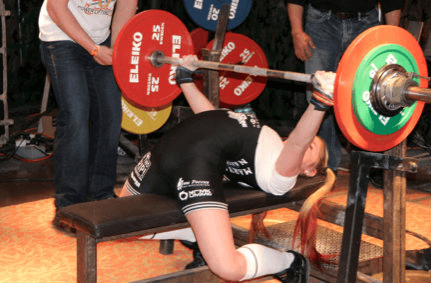
Bench press world records through history
Bench press records have steadily increased over the decades.
Some of the biggest milestones include:
Year | Athlete | Achievement |
1980s | Ted Arcidi | First official 700-pound bench press |
1997 | James Henderson | First official 700-pound raw bench |
2005 | Scot Mendelson | Raw world record surpasses 715 lb |
2015 | Kirill Sarychev | 335 kg raw |
2021 | Julius Maddox | 355 kg raw |
2023 | Jimmy Kolb | 635 kg equipped |
The progression shows that improvements don't come only from stronger athletes.
Training science, nutrition, recovery methods, and equipment have all contributed to heavier lifts.
What makes these athletes so strong?
Elite bench pressers aren't simply born stronger.
Several factors combine to produce record-breaking lifts.
Exceptional muscle mass
Most record holders compete in the super heavyweight division.
More muscle generally means greater force production.
Technical mastery
A record bench press involves:
Perfect bar path
Maximum upper-back tightness
Efficient leg drive
Precise grip width
Excellent timing
Small technical improvements can add several kilograms.
Years of progressive overload
Many elite bench specialists have spent over a decade refining one lift.
Their training cycles carefully manipulate:
Volume
Intensity
Recovery
Accessory exercises
Consistency matters far more than dramatic workouts.
Recovery
Heavy pressing places enormous stress on:
Shoulders
Elbows
Pec tendons
Nervous system
Elite lifters devote as much attention to recovery as they do to training.
Can the world record be broken again?
Probably.
Human strength has continued improving for decades.
Many coaches believe raw bench presses beyond 360 kilograms are realistic, although each additional kilogram becomes dramatically harder to achieve.
Future improvements may come from:
Better programming
Improved injury prevention
Earlier athlete development
Advances in recovery science
However, the closer athletes get to the limits of human performance, the slower progress becomes.
Breaking a world record today often means improving it by only one or two kilograms.
What recreational lifters can learn
Most of us won't bench anywhere near 355 kilograms.
That's perfectly fine.
The biggest takeaway isn't chasing world records.
It's appreciating what consistent training can achieve over many years.
If your bench press improves from:
60 kg to 80 kg
80 kg to 100 kg
100 kg to 120 kg
you're making extraordinary progress in your own journey.
Comparing yourself to world champions isn't productive.
Comparing yourself to last year is.
Frequently asked questions
What is the world record bench press?
The current official all-time raw men's world record is 355 kg (782.6 lb) by Julius Maddox, while the equipped record is 635 kg (1,401 lb) by Jimmy Kolb.
What is the world record bench press female?
The women's official raw world record is 207.5 kg (457.5 lb) by April Mathis. The equipped record is 317.5 kg (700 lb) by Ashleigh Hoeta.
Why are equipped records so much higher?
A bench shirt stores elastic energy during the lowering phase and assists the lifter during the press, allowing substantially heavier weights than raw competition.
Is a gym bench press world record official?
No. Official world records must be performed under sanctioned competition rules with judges, calibrated plates, and federation standards.
Final thoughts
The world record bench press represents far more than raw muscle. It reflects decades of disciplined training, technical refinement, and relentless consistency.
Whether it's Julius Maddox's astonishing 355 kg raw bench or Jimmy Kolb's incredible 635 kg equipped lift, these records remind us how far human performance can be pushed when talent meets years of focused work.
For most lifters, the real victory isn't chasing a world record—it's adding one more plate, one more rep, or one more year of consistent progress.
Got questions? Ping me on LinkedIn.