

طبيبة مقيمة في الطب النفسي، MD، MBBS
شارك هذه القصة
Most people obsess over calories without understanding the one number that actually controls whether they gain fat, lose weight, or maintain their physique: TDEE.
You can eat “healthy.” You can avoid sugar. You can even hit the gym five days a week. But if you consistently eat above or below your Total Daily Energy Expenditure, your body composition will change accordingly.
That’s why understanding TDEE is one of the most useful things you can do for your health and fitness.
And the good news? You don’t need to manually calculate anything anymore.
TL;DR
TDEE (Total Daily Energy Expenditure) is the total number of calories your body burns daily.
It includes your metabolism, movement, exercise, digestion, and even small activities like walking or fidgeting.
Your TDEE determines whether you lose, maintain, or gain weight.
Eating below TDEE usually leads to fat loss.
Eating above TDEE supports muscle gain and weight gain.
Most people fail diets because they guess their calorie needs incorrectly.
Using the free Zorest AI TDEE Calculator helps estimate your daily calorie needs accurately and removes the guesswork.
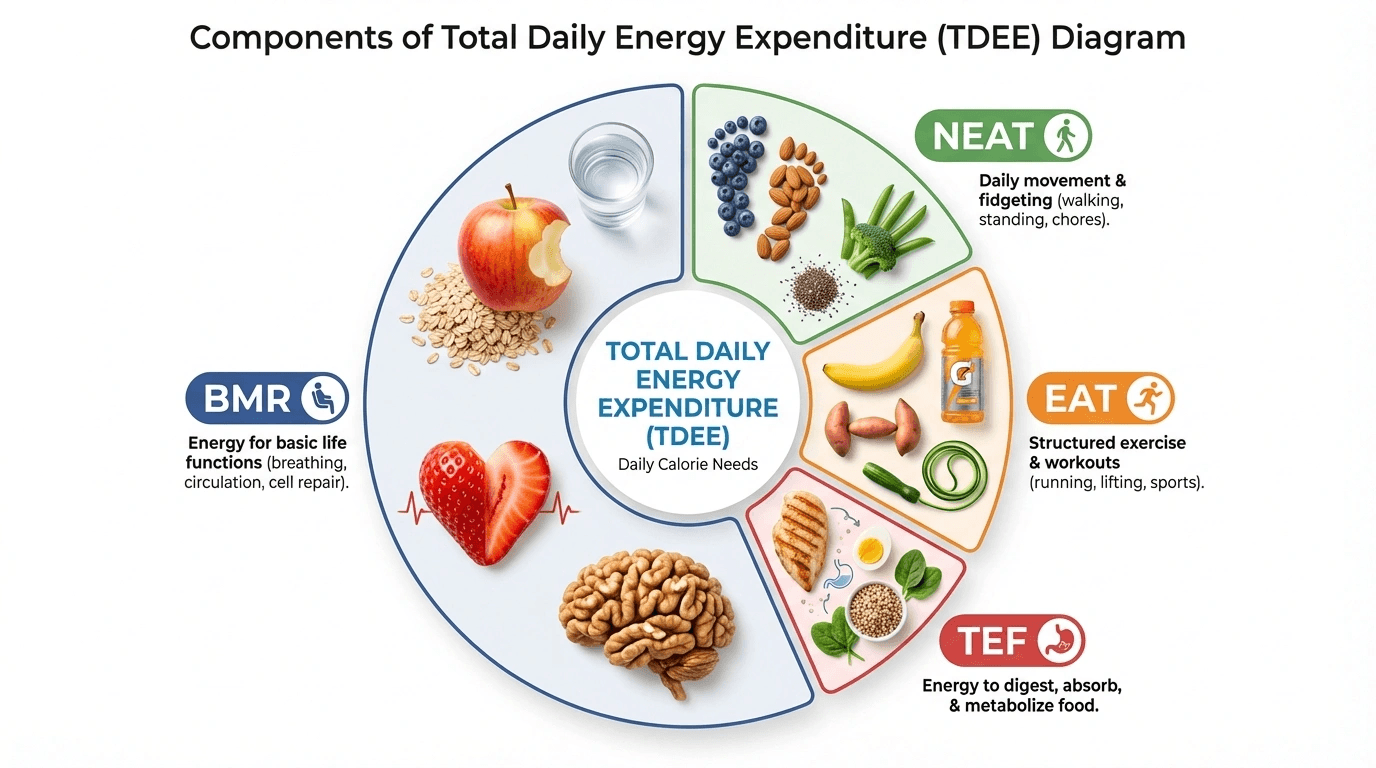
What is TDEE?
TDEE stands for Total Daily Energy Expenditure.
It’s the total amount of energy (calories) your body burns in a day.
This includes:
Calories burned just to stay alive
Calories burned through exercise
Calories burned during daily movement
Calories burned digesting food
Think of TDEE as your body’s daily operating cost.
Even if you stayed in bed all day, your body would still burn calories to:
Breathe
Pump blood
Maintain body temperature
Repair cells
Run your brain and organs
But once you add walking, workouts, chores, work stress, digestion, and movement, your calorie needs rise further.
That full picture is your TDEE.
Why does TDEE matter so much?
TDEE is the foundation of almost every nutrition goal. Here’s the simple reality most people overlook:
Eat below TDEE → you generally lose weight
Eat at TDEE → you generally maintain weight
Eat above TDEE → you generally gain weight
That’s why two people can eat the exact same foods and get completely different results.
A sedentary office worker and a construction worker may both eat 2,500 calories daily. But their TDEE could differ by 1,000+ calories.
One gains fat. The other loses weight.
Same food. Different energy expenditure.
The 4 major components of TDEE
TDEE is not one single process. It’s made up of multiple systems working together.
Understanding these parts helps explain why some people burn more calories than others.
Basal metabolic rate (BMR)
BMR is the number of calories your body burns at complete rest.
It’s usually the largest part of your TDEE.
For most people, BMR accounts for roughly 60–70% of daily calorie burn.
Your BMR powers:
Breathing
Heart function
Brain activity
Hormones
Cell repair
Factors affecting BMR include:
Age
Sex
Muscle mass
Genetics
Body size
People with more muscle generally burn more calories even while resting.
Physical activity
This includes intentional exercise:
Weightlifting
Running
Sports
Cycling
Swimming
Exercise can significantly raise TDEE, but many people overestimate how many calories workouts burn.
I learned this the hard way years ago when I started tracking nutrition seriously.
I assumed my one-hour gym session “earned” me massive cheat meals. But after calculating my actual TDEE, I realized my workouts burned far fewer calories than I thought.
That single realization changed how I approached nutrition completely.
Non-exercise activity thermogenesis (NEAT)
NEAT refers to calories burned outside structured exercise.
This includes:
Walking
Standing
Cleaning
Fidgeting
Taking stairs
Moving around at work
NEAT is massively underrated.
In fact, two people with identical workouts can have dramatically different TDEEs because one moves more throughout the day.
Someone who walks 12,000 steps daily may burn hundreds more calories than someone sitting most of the day.
This is one reason step count matters more than many people realize.
Thermic effect of food (TEF)
Digesting food burns calories too.
Protein has the highest thermic effect, meaning your body burns more energy digesting it compared to fats or carbs.
That’s one reason higher-protein diets often help with satiety and body composition.
TEF usually contributes around 10% of total daily calorie burn.
Why most people calculate calories incorrectly
Most people guess. That’s the problem.
They:
Underestimate portions
Overestimate exercise calories
Ignore activity levels
Follow generic diet plans
Then they wonder why progress stalls.
A 2022 review published in Obesity Reviews found that people commonly misreport calorie intake significantly, especially when trying to lose weight.
This creates frustration because people feel like they’re “doing everything right.”
But without understanding TDEE, nutrition becomes trial and error.
How to calculate your TDEE
TDEE calculators estimate calorie needs using:
Age
Height
Weight
Sex
Activity level
The result gives you an estimated maintenance calorie target.
From there:
Fat loss usually requires a calorie deficit
Muscle gain usually requires a calorie surplus
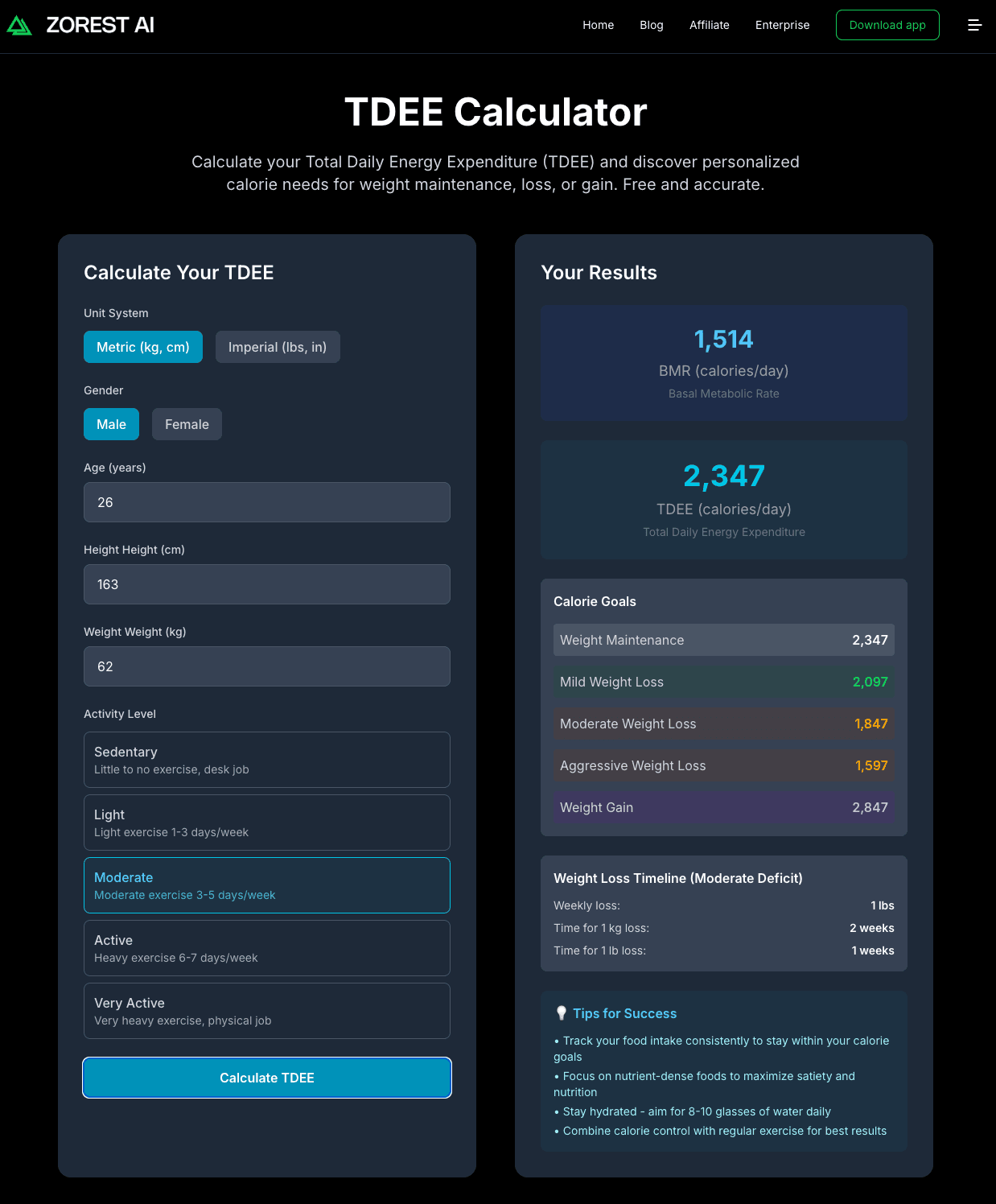
You can calculate your TDEE instantly using the free Zorest AI calculator here:
It’s especially useful if:
You’re starting a fat loss phase
You’re trying to gain muscle without excessive fat gain
You’ve plateaued
You want more accurate calorie targets
Why activity level matters more than people think
The biggest mistake people make during TDEE calculation is selecting the wrong activity level.
Someone who trains 5x weekly but sits all day outside the gym may still have a moderate TDEE.
Meanwhile, a nurse, warehouse worker, or delivery driver may burn far more calories despite doing less formal exercise.
Your daily movement matters enormously.
This is why wearable devices and food tracking tools can help improve accuracy over time.
Why crash dieting often backfires
Extreme calorie deficits can reduce:
Energy levels
Workout performance
Recovery
Daily movement
Many people unconsciously move less when aggressively dieting.
That reduction in movement lowers TDEE further.
This partly explains why aggressive diets become harder over time.
A moderate, sustainable calorie deficit usually works better long-term.
Common myths about TDEE
“Fast metabolism” is usually exaggerated
Many people who appear to have “fast metabolisms” simply:
Move more
Eat less consistently
Have more muscle
Maintain higher daily activity
Genetics matter, but lifestyle usually matters more.
“Exercise burns massive calories”
Most workouts burn fewer calories than people assume.
You cannot out-train chronic overeating consistently.
Nutrition still drives most body composition outcomes.
“Eating too little permanently damages metabolism”
Metabolism can adapt downward during prolonged dieting, but it’s usually not permanently “broken.”
Most people simply need better calorie targets, sustainable dieting, and realistic expectations.
How to use TDEE for your goals
For fat loss
Eat 300–500 calories below TDEE
Prioritize protein
Maintain strength training
Track progress consistently
For muscle gain
Eat 150–300 calories above TDEE
Focus on progressive overload
Prioritize recovery and protein intake
For maintenance
Eat near TDEE
Monitor body weight trends weekly
Consistency matters more than perfection.
Final thoughts
TDEE is not fitness jargon. It’s the foundation behind nearly every physique and nutrition goal.
Once you understand how many calories your body actually burns, nutrition stops feeling random.
You stop chasing fad diets.
You stop blaming carbs.
You stop relying on guesswork.
Instead, you start making decisions based on energy balance and real data.
And honestly, that’s when nutrition becomes dramatically less stressful.
If you want to estimate your calorie needs accurately, start with the free TDEE Calculator from Zorest AI: